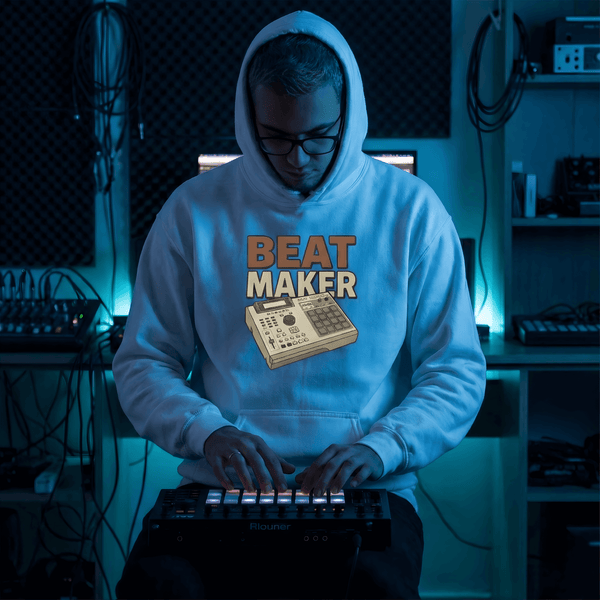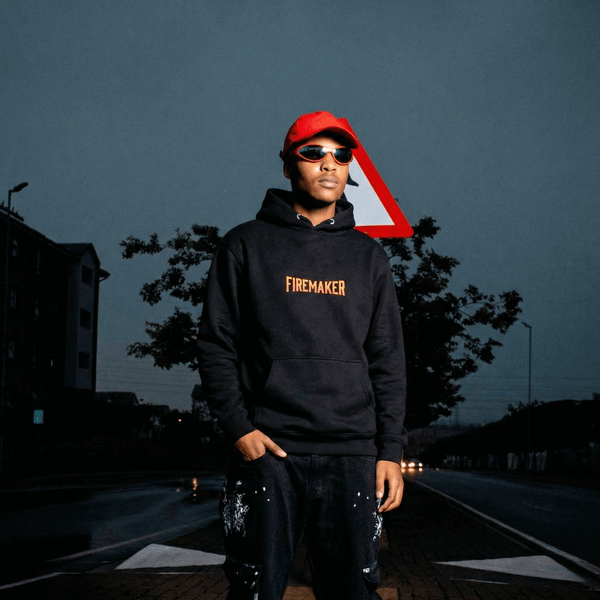

What Rappers Wear to Parties in 2026: The Room-by-Room Guide
A room-by-room guide for the person the party is about: what the club night, the listening session, the release party, the afterparty and the green room each do to clothes, and what survives them.

Most guides to party dressing are written for somebody who bought a ticket. This one is not. If you are the producer whose beat plays at midnight, the rapper on the flyer, the DJ in the booth or the engineer who mixed the record, you are not dressing to blend into a crowd. You are dressing for a room that runs hot, is lit badly on purpose, gets photographed at close range and is still going at four in the morning. Those are physical conditions, and they decide what survives the night.
What to wear it with
Four pieces that match what you are reading. Free shipping, no minimum, 14 day returns.


The short answer
Rappers dress for the room, not for the genre. A club night gets a light tee and dark bottoms, because a packed room runs hot. A release party gets flat black or deep navy and no reflective trim, because direct flash blows out highlights. An afterparty gets a hoodie. A listening session gets whatever you can sit down in for two hours.
Three different people ask this question: one getting dressed for a room tonight, one building a nineties hip-hop costume for a themed party, one who wants to see what the best dressed rappers wore this year. All three get a section below, starting with the one that has a deadline.
Which party are you actually going to?
The word party is doing too much work here. A club night where you are a guest, a listening session where your beat is the reason anybody showed up, a release party with a photographer on payroll and an afterparty at hour six are four environments with four different ways to fail. Picking the wrong one is not a taste problem. It is a category error: the fit was fine, it was built for a different room.
Which party are you actually going to?
A club night, a listening session and your own release are three different rooms with three different temperatures, three different cameras and three different exits. Four questions, then the fit built for the room you are walking into.
The club night: someone else's party
You are not on the flyer. Somebody else is. The job is to look like you belong in the building without pulling focus from the person being celebrated, and to still be in something breathable at 1am.

Start with heat, because heat is what this room does. A venue at capacity is a room full of radiators: several hundred people at body temperature, a bar, kitchen extract and a lighting rig running all night. Temperature climbs until the room empties, and you wear your fit at the top of that curve, not at the door. That is why the jacket you picked in the cold outside spends the night on a hook, and why the layer underneath has to be finished on its own.
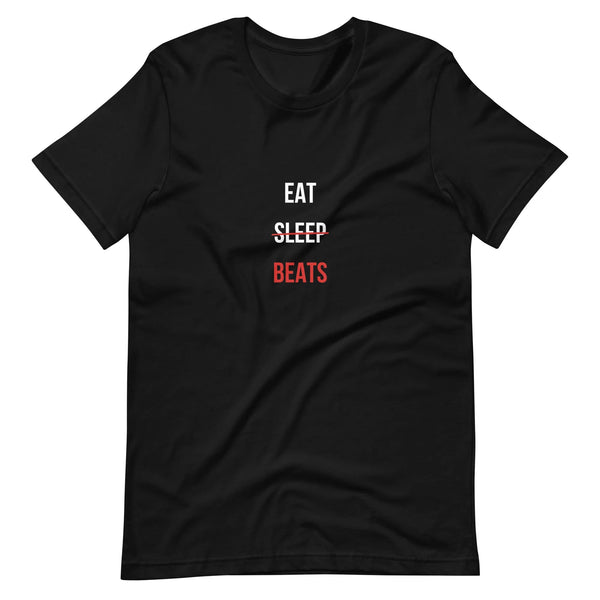
One top, chosen to be seen. A t-shirt at 4.2 oz/yd², which is 142 g/m², is the honest weight for this room. Ghostnote's Eat Sleep Beats t-shirt sits there: 100% combed and ring-spun cotton, pre-shrunk, side-seamed, with shoulder-to-shoulder taping, in Black and Navy from XS to 2XL, $34.99. Side seams matter more here than they sound: a tubular tee twists on the body over a long night, a side-seamed one keeps the graphic pointing forward.

Then colour. Go dark, not because dark reads as cool but because saturated washes overwrite everything else. A club rig points at the floor you are standing on rather than at a stage, so you are lit by it all night. Under a deep magenta or a blue wash, a mid tone you liked in the mirror becomes something you did not pick. Black and navy stay dark under any wash in the building.
Two more things this room does that a ticketed show does not. You move all night between the floor, the bar and whoever is holding the booth, so the fit gets read at arm's length and from every side instead of from behind in one fixed spot, which makes the back of a garment count as much as the front. And you leave when the host's night ends rather than when a set finishes, so whatever you picked has to hold through a hot room for the full run of it.
The listening session: twenty people and your beat
Twenty people in a room with a pair of monitors. No stage, no rig, no barrier. You are at the desk or standing beside it, and for the ninety seconds your track plays, nineteen people are watching your face for a tell. Nobody is looking at your shoes.

You are seated for most of it, and a fit built standing in front of a mirror falls apart in a chair: the top rides up, the bottoms bunch at the knee, and the shoe nobody was going to see sits at eye level for the person opposite. Sit down in it before you leave the house. Ten seconds, and it is the most useful check on this page.
The light here is overhead or a lamp in a corner, never a wash. It digs shadows into eye sockets and drops a hard line of shade off any brim. If you are the one talking, push the cap back, because a room that cannot see your eyes reads you as somewhere else.
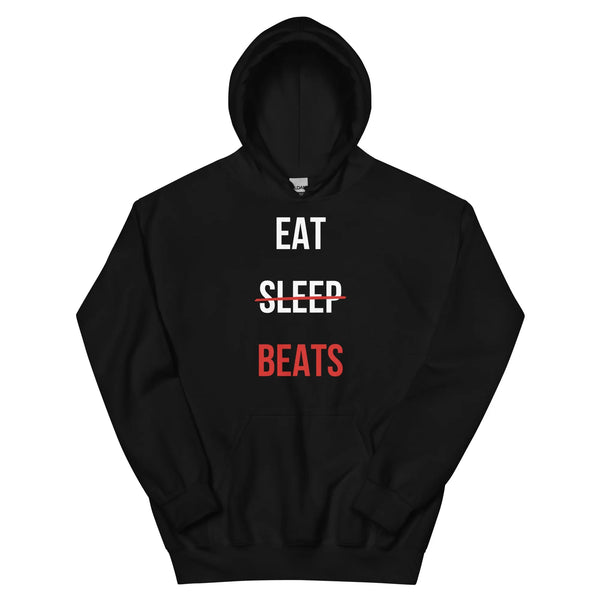
The room is also quiet between plays, and this is the part people miss. Hard nylon shells, heavy zip pulls and loose jewellery make noise when you reach across a desk, and everybody hears it. A hooded sweatshirt wins on sound alone, and so do cuffs that stay put: the 1×1 athletic rib knit with spandex on the Eat Sleep Beats hoodie holds a pushed-up sleeve instead of letting it slide back over your hand while you ride a fader.
The release party: the one that gets photographed
This is the room where the camera is the audience. A release party exists to produce images, so your fit is judged as a still photograph at chest height, cropped, shot from six feet away, lit by a flash that was not there a second earlier.

Direct on-camera flash is a hard, close light source. It lifts exposure fast, so pale surfaces clip to paper white while anything in shadow drops to black. A garment built on tonal subtlety loses that subtlety on contact. Flat black or deep navy with a high-contrast graphic holds, because what reads from across a room is what survives a blown-out exposure: one strong edge between light and dark.
Reflective trim is the trap nobody checks for. Retroreflective material, the kind used on safety clothing, is defined as a surface that reflects light back to its source with minimum scattering. Put that on a jacket, stand in front of a photographer, and every frame comes back with a white bar burned across your chest. Gloss does a smaller version: satin, coated nylon and patent leather throw highlights back at the lens. Matte photographs the way it looks.
None of this shows while you are getting dressed, because a mirror only gives you the room light. It shows up the instant a camera fires.
What your fit actually looks like after 9pm
You choose an outfit under a bathroom light and then wear it under three completely different ones. Tap through the lighting a party actually throws at you and watch the same hoodie change its mind.
 Room light
This is the version you checked in the mirror. It is also the only version nobody at the party is going to see.


Under a plain room light all four colourways read as themselves. This is the last moment tonight that will be true.
The afterparty: hour six
Hour six is a different climate from hour one. The room was hot. The street at 3am is not, and you have been sweating in cotton for five hours, so that cotton is now cold against your back. This is the hour that decides whether you stay out, and one garment decides it.

A midweight hooded sweatshirt is the piece. The Eat Sleep Beats hoodie runs 8.0 oz/yd², which is 271 g/m²: warm enough for a cold street, not so heavy it cooks you back inside a kitchen. It is 50% pre-shrunk cotton and 50% polyester, with a double-lined hood and matching drawcord, a quarter-turned body so there is no crease down the middle, ribbed cuffs and waistband that hold warmth at the wrists and hips, and a front pouch for a phone and keys. Black, Navy and Beige run S to 3XL, Gray runs S to 2XL, $49.99.

Most orders arrive in 4 to 14 days, depending on your location. Returns and exchanges run 14 days, the piece comes back as new, and return shipping is free.
You do not get to choose an outfit for hour six. Whatever you left the house in is what you are wearing, because nobody goes home to change at 2am. The afterparty is decided at the door of the first venue.
Backstage, the green room and the house session
These are work rooms with a party happening in them, and they have the strangest temperature profile on this list. Green rooms tend to run cold while the building is still empty: concrete floors, load-in doors propped open, extraction pulling air through the place. You sit in that cold for ninety minutes, do twenty-five of the hottest minutes of your year, then come off wet into the same cold room. The answer is a layer you can pull off in one motion and put back on without redoing anything underneath, which is why the hoodie lives backstage as much as at the afterparty. You will also be handling cases and cables, which rules out loose sleeves and pale bottoms.

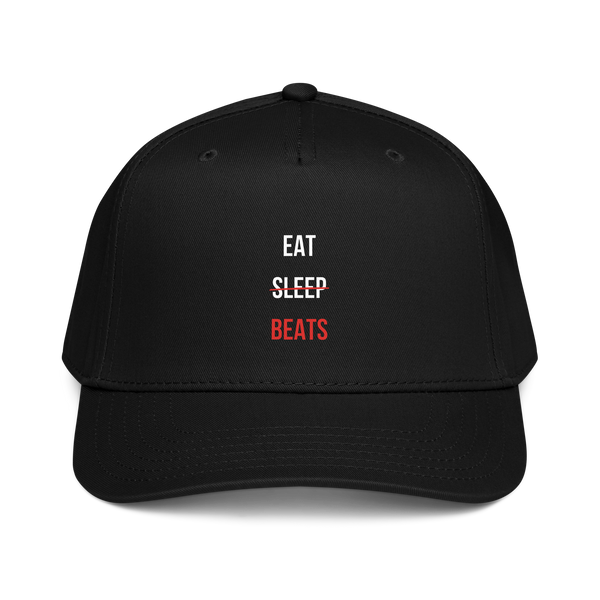
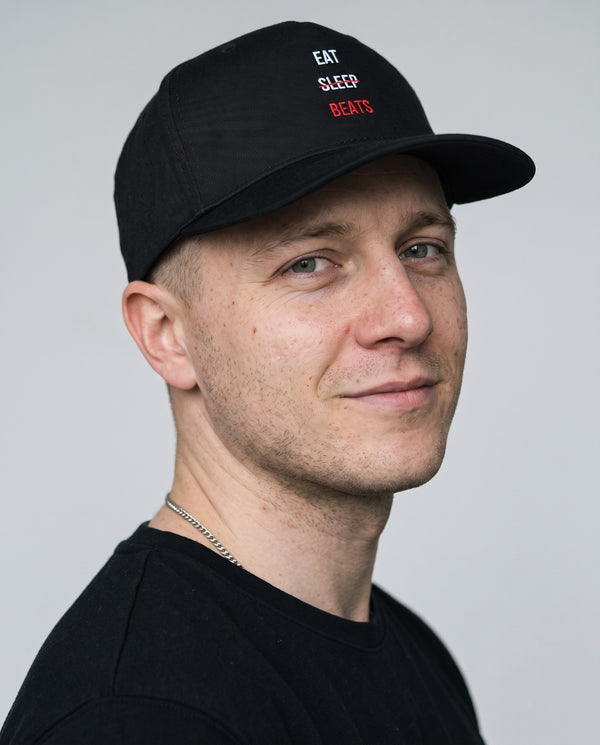
Headwear here is a tool, and it does one job: it decides whether people can see your eyes. Backstage, under overhead light with an hour to wait, shade is welcome. On a mic in front of twenty people it is not. The Eat Sleep Beats cap is a structured mid-profile five-panel in 65% polyester and 35% cotton twill, with a slightly curved visor, an adjustable snap closure and a matching undervisor and sweatband, one size fits most, $29.99. Structured means it keeps its crown after a night in a bag. If the room is cold rather than bright, a knit does the job with more warmth, and we compared those in our guide to the best beanies for rappers and producers.

The house session is the opposite climate. A small apartment, a laptop, an interface, monitors and twelve bodies all making heat, no ventilation, and you are on the floor for most of it. Whatever you sit on that floor in is what you go home in. This is a room for the tee, with the hoodie on a chair for when you leave.

Building the wardrobe underneath all this is a different job, covered in how to dress like a rapper in 2026.
Door policy: in or out?
Door policies vary by venue, by city and by night, and the call gets made in about two seconds by somebody who will not explain it. There is no universal list. What exists is the venue's own page, and that is the only one binding the door you are standing at. Time Nightclub in Costa Mesa publishes a code on its own site refusing sandals and flip-flops, shorts, tank tops and sportswear including t-shirts and jerseys, with DJ merch written in as an exception. Two rooms in the same city can refuse opposite things, so read the page for the room you are going to. It takes less time than the queue. Being on a list changes the odds but does not remove the door.
The useful skill is calling it yourself before somebody else does.
Door policy: in or out?
Eight fits arrive at the front of the queue. You get about two seconds each, which is roughly what a door gives you. Call it, then find out which pattern you just met.
If it's a hip-hop theme party, read this instead
If the invite says nineties hip-hop night or 2000s throwback, everything above is the wrong advice, because a costume and a fit solve opposite problems. A fit needs to look like it belongs to you. A costume needs to read across a room in one second, which means exaggeration: volume pushed past where you would wear it, the era's loudest signals all at once, and none of the restraint an outfit needs in daylight.
The markers people reach for are baggy denim, jerseys over long sleeves, bucket hats, velour and nylon tracksuits, chunky sneakers and a lot of logo. Our ultimate guide to the Y2K rapper outfit walks that wardrobe piece by piece with the labels and the timeline.
One line worth keeping: dress the era, not a person. Clothes are the theme. A costume that turns a specific artist into a bit lands badly in these rooms.
What the best-dressed rappers actually wore in 2026
Complex published its best dressed rappers of 2026 list in June, written by Mike DeStefano, with Playboi Carti at the top. What follows is what that piece reports.
- Playboi Carti. The murdered-out 00pium aesthetic with a dose of Demna's Gucci, red Margiela Futures sneakers, and pieces from under-the-radar designer Andreas Aresti's label Lourdes.
- ASAP Rocky. Chanel and Jonathan Anderson's Dior, with button-ups, ties and leather trench coats. On stage during the Don't Be Dumb tour: baggy denim, an oversized graphic tee and an AWGE balaclava.
- Lil Yachty. Chrome Hearts pants, Takashi Murakami x Louis Vuitton fanny packs and vintage Shrek tees, worn at the wrestling ring as a manager for Trick Williams.
- Bad Bunny. An all-white custom Zara look for the Super Bowl LX halftime performance, a 100-plus-piece Zara apparel collection, and his first original sneaker silhouette with adidas, the BadBo 1.0.
- Tyler, The Creator. Chinos, a collared shirt, loafers and a vintage watch as a uniform, plus a silk map knit cardigan from Supreme Fall/Winter 2023 at the Roots Picnic.
- Action Bronson. A striped linen shirt with pink pants and a two-piece suit on a Sicily trip, and a full vintage Patrick Ewing kit during the Knicks Finals run.
- Jay-Z. A Fear of God set on the Roots Picnic stage in Philadelphia, and a Bode shirt with clean white Air Force 1s at Madison Square Garden for the NBA Finals.
- Travis Scott. Chrome Hearts pants, a rare nineties T-shirt, his own Air Jordans, an Audemars Piguet and Oakley shades.
- Lil Uzi Vert. Demna's Gucci accessorised with neon fox tails, Dracula pieces from Jonathan Anderson's Dior, and a Sega-inspired Saint Michael jacket on Fallon.
- Molly Santana. Rick Owens and Hysteric Glamour, black grills, and a blend of punk rock, Y2K and Japanese high fashion.
Read that list as a party guide and two things jump out. Almost every entry is a repeated formula, not a one-off: Complex describes Travis Scott's wardrobe as "somewhat formulaic" and calls Tyler an exception to the rule that uniform dressing grows dull. And almost every fit is one loud element on a plain base, which is what survives a flash and a crop.
Silhouette in 2026 is not the single direction people assume. Trendalytics reported in April that rigid tailoring is being replaced by relaxed silhouettes, with searches for relaxed tailoring up 554%. Style Arcade, on the men's Fall/Winter 2026-27 shows in February, logged barrel leg pants up 243% year on year for men's arrivals in 2025 while noting an obvious lean to trimmer, slimmed-down silhouettes in tailoring. Both run at once, so proportion is settled by the room and not the season: volume where you want to be seen, a leaner line wherever you sit, stand in a crowd or lift something.
On sourcing, we mapped where rappers get their clothes across five channels, and the pieces we make for the people behind the records sit in outfits for rappers.
Three things that ruin a party fit
- White, in a room with UV. Optical brightening agents are added to textiles and to many laundry detergents, and they work by absorbing invisible ultraviolet and re-emitting it as blue light, which is why the colour science firm X-Rite says they are easy to detect under a black ultraviolet light. A freshly washed white tee glows under a blacklight, and it shows the marks the night puts on it.
- Trim that returns the flash. Invisible until the photos land. Reflective piping, printed reflective graphics and reflective laces all send the flash straight back down the lens.
- The layer with nowhere to go. Plenty of rooms have no coat check. Bring a jacket you cannot tie or stuff and you spend the night holding it, which is the fastest way to look like you are on your way out.
Frequently asked
What to wear to a hip hop party?
A dark t-shirt or a hoodie with one strong graphic, relaxed dark bottoms, and clean sneakers you can stand in for six hours. Pick the top for the temperature of the room, not the street, because a venue at capacity runs far hotter. If there is a photographer, go matte and skip reflective trim. A themed night is a costume brief instead, covered above.
What is the 3-3-3 rule for clothes?
A capsule wardrobe exercise. Trendalytics describes it as selecting 3 tops, 3 bottoms, and 3 pairs of shoes that combine easily, and notes those nine items can produce over 20 outfits. It is a packing and decluttering framework, not a rule about parties. It matters here for one reason: if your nine pieces cannot cover a hot room and a cold street on the same night, the nine are wrong.
What do guys usually wear to parties?
At a house party or a bar, the default is a t-shirt or a knit with jeans or relaxed trousers and sneakers, plus a jacket for the journey. At a club with a door policy, the same outfit with the sportswear taken out and the shoes upgraded. The variable is the venue, not the season: a club with a published dress code tells you what it refuses.
What to wear to a fetty wap concert?
A rap show you bought a ticket to is a different problem from the rest of this page, because nobody is photographing you and no door is judging your shoes. Dress for a hot, crowded standing room: a t-shirt you do not mind sweating through, bottoms with a zipped pocket, and sneakers you can stand in for three hours. Leave the jacket in the car if the room has no coat check, and check the venue's bag policy before you travel, because that one is published in advance and enforced at the entrance.
Wear it
The pieces this guide is built around. Every one ships free, no minimum.