
What Is a Ghost Note? Meaning, Examples, and Why We're Named After One

A ghost note is a note played so quietly that it is felt more than heard: a muted snare tap, a dead-string pluck, a barely-there hit tucked between the main beats. Ghost notes add groove, swing and human feel to a rhythm without changing the pattern itself.
Ask a drummer what holds a groove together and they will not point to the loud hits. They will point to the quiet ones.
A ghost note sits underneath the main rhythm, almost silent, yet pull it out of a beat and the whole thing goes stiff. The ghost note meaning runs deeper than volume: it is the difference between a pattern that ticks and a pattern that breathes. It is also why we named a clothing brand after it, a short story we save for the end, after the actual theory.
The same instinct scaled up into a whole genre's low end. For that story, read how the Roland TR-808 became hip-hop's heartbeat.
What to wear it with
Four pieces that match what you are reading. Free shipping, no minimum, 14 day returns.




What is a ghost note? The textbook definition
The textbook definition is a note played at very low volume, often with little or no discernible pitch. On a drum kit it usually lives on the snare: between the strong backbeats on two and four, a drummer taps faint sixteenth notes with the stick barely lifting off the head.
In standard notation it is written as a notehead wrapped in parentheses, an instruction that says strike it, then swallow most of the sound. Fully muted, pitchless strokes often get an X notehead instead. Either way, the point is not the note itself. The point is the space around it.
A ghost note is deliberate, practiced and precise, which is the opposite of the slip of the hand it gets mistaken for. It takes more control than a loud hit, because hitting hard is easy and hitting almost-nothing-at-all is a skill. The musician is choosing to disappear into the groove on purpose.
Players use the term two ways. Some mean a note with no real pitch at all, like a muted scratch on a guitar string or a dead stroke on a bass. Others mean any note played at a whisper next to the accents around it. Both are right, and both share the same intent: the rhythm should register without the note ever stepping into the foreground.
Why you feel it but never hear it
Human rhythm works on contrast. Your ear locks onto the accented hits (the kick, the backbeat) and files everything quieter under texture and forward motion. Ghost notes fill the gaps between the loud moments with low-level activity, so the groove feels continuous instead of stop-start. Musicians call the result the pocket, the bounce, the shuffle. You do not consciously hear each ghosted tap, but your body counts them, and your head starts to nod.
The key word is contrast. Dynamics in music are relative, so a ghost note only works if the accents around it stay strong. Flatten everything to one volume and there is nothing left to feel. That is exactly what goes wrong when a beat gets quantized to death. More on that in a minute.
Ghost notes on the drum kit
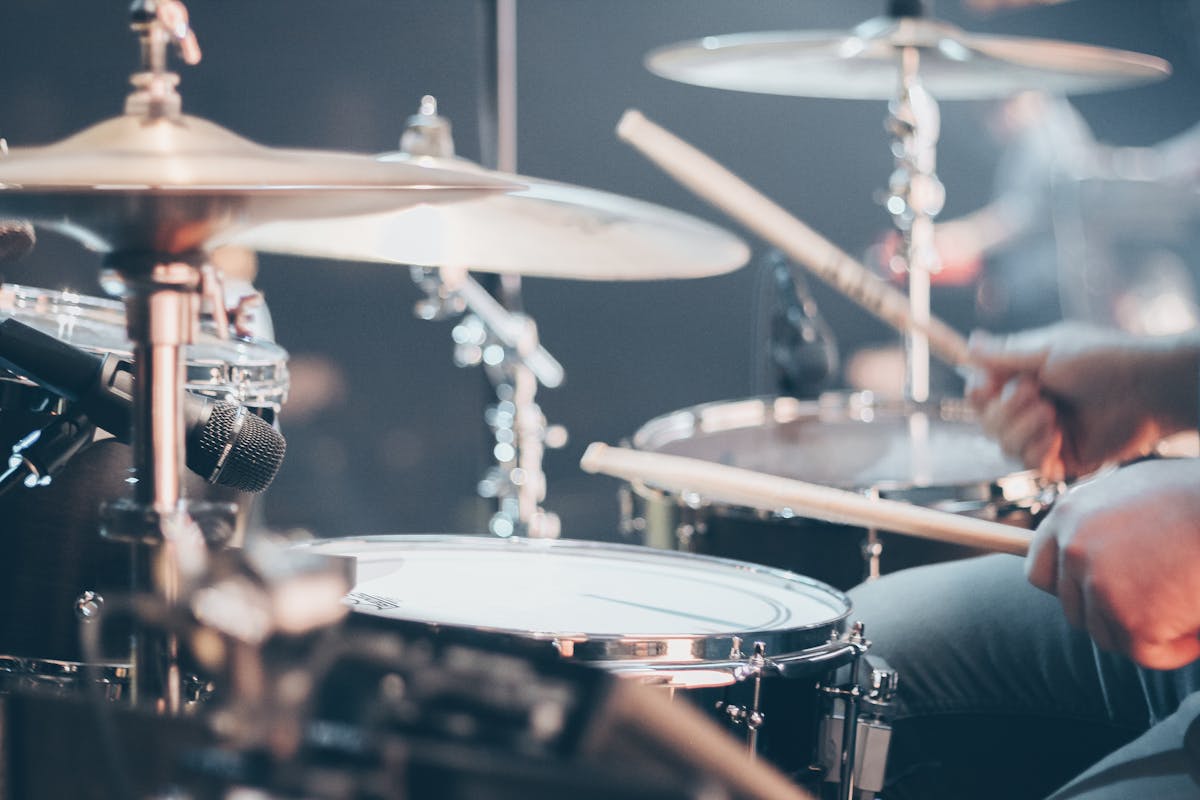
The classic funk snare pattern is a small dynamic miracle: cracking backbeats on two and four, and between them, ghosted sixteenths played so low the stick tip stays an inch or two off the head. Same drum, same hands, two completely different jobs.
Drummers spend years widening that gap, making the loud notes louder and the quiet notes quieter, because the gap is the groove. If you play, Drumeo's ghost note lesson isolates exactly that stick control, with exercises for working ghosts into a beat without dropping the backbeat.
The recorded canon proves the point. Three grooves everyone has heard, all built on the quiet hits:
- "Funky Drummer" (James Brown, 1970), Clyde Stubblefield. One of the most sampled drum performances ever recorded. The loud hits give it a skeleton, the ghosted sixteenths give it the slink.
- "Home at Last" (1977) and "Babylon Sisters" (1980), Bernard Purdie with Steely Dan. The Purdie shuffle: a half-time feel wrapped in rolling ghosted triplets, where the ghost strokes sit quieter than the hi-hat.
- "Fool in the Rain" (Led Zeppelin, 1979), John Bonham. Bonham's rework of that same shuffle, and the reason most drummers meet the idea through rock rather than funk.
Play any of those with the ghost notes stripped out and you get something technically correct and completely lifeless, like a joke read off a card.
Ghost notes on bass: the dead-note click
Bass players have their own version. Lay the fretting hand across the strings without pressing down to the fret, pluck, and you get a percussive, pitchless click: a dead note. Slot those clicks between the real notes of a line and the bass starts doing two jobs at once: melody instrument and drum.
Strip them away and the bassline still plays the same pitches, but it loses its swing and its funk. The information was never in the loud part. It was hiding in the quiet.
Fingerstyle funk turned this into a language of its own. Tower of Power's Francis "Rocco" Prestia built entire basslines from muted sixteenth notes with only a handful of real pitches poking through, and slap players use dead notes the same way, as connective tissue between the slaps and pops that actually get heard.
The ghost note in hip hop
Funk built its language on ghost notes, and hip hop inherited it wholesale. When producers started sampling those records and chopping those breaks, the ghost notes came along for the ride, baked into the audio between the hits everyone was actually chasing.
That inheritance is part of why classic boom bap feels loose and warm in a way a stock drum-machine pattern does not. A "Funky Drummer" chop carries Stubblefield's touch into a record made by someone who never met him.
Modern beatmakers recreate the effect on purpose. They lower the velocity on certain drum hits, nudge them slightly off the grid, and let those ghosted layers sit deep in the mix. J Dilla turned that idea into a whole aesthetic: drums that lurch and drag like a player leaning behind the beat, shaped hit by hit instead of snapped to the grid. The principle never changed from the funk era. The quiet hit still does the heavy lifting.

How to program ghost notes in your DAW
If your beat sounds robotic, the fix is almost never another sample pack. It is dynamics. Quantize every hit to dead center and push every velocity to maximum and you have built a metronome with good sound design. Ghost notes are how you un-build it:
- Drop velocities hard. Add snare hits on the sixteenths around the backbeat (the "e" and the "ah") and pull their velocity way down; somewhere around a third of the main hit's level is a sane starting point. They should vanish when you stop listening for them. Tune by ear, not by number.
- Get off the grid. Nudge a few ghosts slightly late or early, or lean on your DAW's swing. Low-volume hits sitting just off the grid are most of what people mean when they say "human feel."
- Change the sound, not just the level. A real drum struck softly sounds different, not just quieter. Many producers use a second, softer snare layer for ghosts, or low-pass the main sample a touch, so the quiet hits read as texture instead of a broken volume fader.
- Ghost the hats too. The same velocity contour applies to hi-hats: accents on the anchor points, everything between pulled down. A flat-velocity hat line is the fastest way to sound like a preset.
- Leave the loud hits loud. Ghost notes only work against contrast. If everything is quiet, nothing is a ghost.
If you are new to building beats and want to hear the difference for yourself, Ableton's free Learning Music site runs entirely in the browser. Sketch a drum pattern, change one hit's level, and listen to what the groove gains or loses. For the tools that handle the theory side inside your DAW (keys, chords and voicings), see the best music theory plugins.
Why we named a brand after it
Quick disclosure: this is the one branded section in the article. Ghostnote makes clothing and audio plugins. No affiliate links here or anywhere else on this page, just the story behind the name.
The ghost note is the perfect symbol for the people we make clothing for: producers, beatmakers, engineers, the writers and players who never step in front of the camera. Their work is everywhere in the song and their name is almost nowhere on it. They are the soft hit you feel but never hear. The track would fall apart without them, and most listeners will never know they existed.
We don't say that as a complaint. The best work in music is often the work nobody notices, the choices holding the whole thing together from underneath, and we built the brand on that idea. Everything we make follows one rule: designed by makers, for makers, never printed for fans. Graphics that speak the language of the studio instead of shouting a logo. That philosophy is the heart of the Ghostnote story, and it runs through music producer outfits: hoodies and tees that talk about the craft, not the clout.
The name runs through the audio side of the company too. We build plugins for the same people, and the link to this article is direct: compression is the fastest way to erase a ghost note. Clamp every hit to one level and the soft ones stop being soft, which was the whole point of playing them. The full line sits on the plugins page. The de-esser below is free, and it installs on every machine you own.

De-esser · Free forever
Ghostnote VEIL
Split-band by design, so the body of the voice cannot be touched. Our probe measured 300 Hz at −0.00 dB while 4.6 dB of de-essing was working, and an "ss" at −9 and −29 dBFS both got exactly 10.0 dB. The full plugin, free, keyless.
Get VEIL free →Ghost note FAQ
What is a ghost note in simple terms?
A note played so quietly it is felt more than heard, usually a soft snare tap or a muted bass pluck sitting between the main hits of a rhythm. It adds bounce and momentum without adding volume.
What is the difference between a ghost note and a grace note?
A grace note is an ornament: a quick decoration crushed in just before a main note, stealing a sliver of its time. A ghost note is a full member of the rhythm with its own place in the bar; it is simply played at a whisper. Grace notes decorate a note; ghost notes carry a groove.
How are ghost notes written in sheet music?
The standard convention is a notehead wrapped in parentheses, telling the player to strike that note at a much lower dynamic than the notes around it. Fully muted, pitchless strokes (like dead notes on bass or guitar) are usually written with an X notehead instead.
Are ghost notes only played on drums?
No. Drummers own the term, but bassists use dead notes constantly, guitarists mute strings for percussive scratches, and producers recreate the whole effect with velocity in a sequencer. Any instrument that can play quietly on purpose can play a ghost note.
For the makers nobody notices
A ghost note holds the groove together without ever asking for credit. So does most of the best work in music. If you are the one pulling snare velocities down at 3am, the one who hears the difference a quiet hit makes, you already understand the name on the label better than we could explain it. Play the quiet part loud.
Wear it
The pieces this guide is built around. Every one ships free, no minimum.