
Trap Drum Patterns: 8 Grids With Free MIDI
8 trap drum patterns as 16-step grids, from a basic half-time beat to triplet hats, 1/32 rolls and 808 slides, each with a free MIDI file and FL Studio and Ableton tips.

A trap drum pattern at 140 BPM is a half-time bar: the snare and clap land once, on step 9 of 16 (beat 3), the kick takes beat 1 and a few off-beat steps that the 808 follows, and the hi-hats carry the movement with rolls, triplets and changes in velocity. Below are 8 trap drum patterns as step grids you can copy by eye, each with a free MIDI file you can drag into FL Studio, Ableton Live or any DAW. No email, no sign-up.
Every grid on this page and every MIDI file was generated from the same data, so what you see is what you download. They are our own patterns: free to use in your own beats, royalty-free. No affiliate links.
What to wear it with
Four pieces that match what you are reading. Free shipping, no minimum, 14 day returns.

How to read the grids
Each grid is one bar of 4/4 split into 16 steps, one step per 16th note, the same layout as the 16 step buttons on a Roland TR-808. Step 1 is beat 1, step 5 is beat 2, step 9 is beat 3 and step 13 is beat 4. The coloured header bands follow the 808’s own button colours, one band per beat.

The 16 step buttons that every trap grid still copies. Photo: 1904.CC, Wikimedia Commons, CC BY 4.0.
- ● one hit at full velocity. ○ a ghost hit, played soft.
- 2 two 1/32 notes inside the step. 4 four 1/64 notes inside the step.
- 3 across two steps: three 1/16 triplets in the space of an 8th note. 3 in a single step: three 1/32 triplets.
- 808 row (patterns 5 and 7): the bass note and how long it holds. An arrow means the note overlaps the next one, which is what makes it glide.
The MIDI files put the drums on channel 10 with General MIDI drum notes: kick 36, snare 38, clap 39, closed hat 42, open hat 46. If your kit is mapped differently, drag each row onto your own sounds. The two files with an 808 row carry the bass on a separate track, channel 1.
The 8 trap drum patterns
They run from bare skeleton to busier grooves. Loop each one for four bars before you change anything, then make bar 4 the bar where the roll or the extra kick happens.
1. Basic half-time (140 BPM)
| Step | 1 | 2 | 3 | 4 | 5 | 6 | 7 | 8 | 9 | 10 | 11 | 12 | 13 | 14 | 15 | 16 |
|---|---|---|---|---|---|---|---|---|---|---|---|---|---|---|---|---|
| Kick | ● | ● | ||||||||||||||
| Snare | ● | |||||||||||||||
| Clap | ● | |||||||||||||||
| Hi-hat | ● | ● | ● | ● | ● | ● | ● | ● |
Kick on 1 and 11, snare and clap stacked on 9, closed hats on every 8th note. This is the skeleton every other grid builds on. With the snare once per bar, 140 BPM reads as 70, the half-time feel that Wikipedia’s trap music article places around "70 (140) BPM" for a typical beat. Start here, then swap the kick on 11 for 12 and hear how much the bounce changes for one step.
Download MIDI: Basic half-time (140 BPM)
2. Triplet hats
| Step | 1 | 2 | 3 | 4 | 5 | 6 | 7 | 8 | 9 | 10 | 11 | 12 | 13 | 14 | 15 | 16 |
|---|---|---|---|---|---|---|---|---|---|---|---|---|---|---|---|---|
| Kick | ● | ● | ● | |||||||||||||
| Snare | ● | |||||||||||||||
| Clap | ● | |||||||||||||||
| Hi-hat | ● | ● | 3 | ● | ● | ● | 3 | ● | ||||||||
Same snare, a third kick on step 8, and two triplet groups: three hats across steps 5 to 6 and again across 13 to 14. A triplet against a straight grid makes the hat line stumble forward for a moment, then land back on the 8ths. Two triplet spots per bar is plenty. Put them everywhere and the groove stops feeling like it has a grid at all.
Download MIDI: Triplet hats (140 BPM)
3. Hat rolls in 1/32
| Step | 1 | 2 | 3 | 4 | 5 | 6 | 7 | 8 | 9 | 10 | 11 | 12 | 13 | 14 | 15 | 16 |
|---|---|---|---|---|---|---|---|---|---|---|---|---|---|---|---|---|
| Kick | ● | ● | ● | |||||||||||||
| Snare | ● | |||||||||||||||
| Hi-hat | ● | ● | ● | ● | ● | ● | 2 | 2 | ● | ● | ● | ● | ● | ● | 4 | 2 |
Straight 16th hats with three rolls: 1/32 doubles on steps 7 and 8 that run into the snare, a four-note 1/64 burst on 15, and one more 1/32 pair on 16 to throw into the next bar. That placement, right before the snare or at the end of the bar, matches what eMastered’s trap drum guide recommends. In the file, velocity climbs inside each roll (66, 78, 90, 102 on the 1/64 burst), so the roll swells instead of buzzing at one level.
Download MIDI: Hat rolls 1/32 (140 BPM)
4. Snare variations
| Step | 1 | 2 | 3 | 4 | 5 | 6 | 7 | 8 | 9 | 10 | 11 | 12 | 13 | 14 | 15 | 16 |
|---|---|---|---|---|---|---|---|---|---|---|---|---|---|---|---|---|
| Kick | ● | ● | ||||||||||||||
| Snare | ● | ○ | 2 | 2 | ||||||||||||
| Clap | ● | |||||||||||||||
| Hi-hat | ● | ● | ● | ● | ● | ● | ● |
The main snare stays on 9 with the clap. A ghost snare on 12 (velocity 62) fills the gap before beat 4, and a 1/32 snare roll on 15 and 16 pushes into the next bar. The clap stays on 9 only, so the ghost and the roll read as the snare talking, not as a second backbeat. Use this one as your bar 4 or bar 8 variation and keep pattern 1 for the bars in between.
Download MIDI: Snare variations (140 BPM)
5. 808-locked kick
| Step | 1 | 2 | 3 | 4 | 5 | 6 | 7 | 8 | 9 | 10 | 11 | 12 | 13 | 14 | 15 | 16 |
|---|---|---|---|---|---|---|---|---|---|---|---|---|---|---|---|---|
| Kick | ● | ● | ● | ● | ● | |||||||||||
| Snare | ● | |||||||||||||||
| Clap | ● | |||||||||||||||
| Hi-hat | ● | ● | ● | ● | ● | ● | ● | ● | ||||||||
| 808 | F1 | F1 | Ab1 | Eb1 | F1 | |||||||||||
The kick hits on 1, 4, 7, 11 and 14, and the 808 starts on exactly the same steps: F1, F1, A♭1, E♭1, F1, in F minor. Those are about 43.7, 51.9 and 38.9 Hz at the fundamental (MIDI notes 29, 32 and 27; FL Studio and Ableton print different octave numbers for the same note, so go by the note number). Locking the two means the kick supplies the click and the 808 supplies the note, so they stop fighting for the same moment. Change the 808 notes to your key; keep the rhythm.
Download MIDI: 808-locked kick (140 BPM)
6. Bounce kick
| Step | 1 | 2 | 3 | 4 | 5 | 6 | 7 | 8 | 9 | 10 | 11 | 12 | 13 | 14 | 15 | 16 |
|---|---|---|---|---|---|---|---|---|---|---|---|---|---|---|---|---|
| Kick | ● | ● | ● | ● | ● | |||||||||||
| Snare | ● | |||||||||||||||
| Clap | ● | |||||||||||||||
| Hi-hat | ● | ● | ● | ● | ● | ● | ● | ● | ● | ● |
Kicks on 1, 6, 8, 11 and 14: three of them (6, 8 and 14) land on the "e" or the "a" of a beat rather than on an 8th note, which gives the pattern its skip. The hats add 16ths on steps 6 and 14 so they answer the off-beat kicks. If it feels busy, drop the kick on 14 first. The groove survives; the pattern just breathes more.
Download MIDI: Bounce kick (140 BPM)
7. Drill-adjacent slide (142 BPM)
| Step | 1 | 2 | 3 | 4 | 5 | 6 | 7 | 8 | 9 | 10 | 11 | 12 | 13 | 14 | 15 | 16 |
|---|---|---|---|---|---|---|---|---|---|---|---|---|---|---|---|---|
| Kick | ● | ● | ||||||||||||||
| Snare | ● | ○ | ||||||||||||||
| Clap | ● | |||||||||||||||
| Hi-hat | ● | ● | ● | ● | ● | ● | 3 | |||||||||
| 808 | F1 ↗ | C2 | ||||||||||||||
Hats grouped 3+3+2 (steps 1, 4, 7, then 9, 12, 15) with a 1/32 triplet on 16, a sparse kick, and an 808 that holds F1 for most of the bar before gliding up to C2 on step 11. Wikipedia’s UK drill article describes drill hats moving from on-beat and triplet subdivisions "to a steady 3+3+2" pattern, tempos of about 138 to 151 BPM and a sliding bass. It also notes the snare moving to the fourth beat every two bars, which a one-bar loop cannot show: for the full drill feel, copy this bar and move the snare later in bar 2.
Download MIDI: Drill-adjacent slide (142 BPM)
8. Open-hat accents
| Step | 1 | 2 | 3 | 4 | 5 | 6 | 7 | 8 | 9 | 10 | 11 | 12 | 13 | 14 | 15 | 16 |
|---|---|---|---|---|---|---|---|---|---|---|---|---|---|---|---|---|
| Kick | ● | ● | ● | |||||||||||||
| Snare | ● | |||||||||||||||
| Clap | ● | |||||||||||||||
| Hi-hat | ● | ● | ● | ○ | ● | ● | ● | ○ | ||||||||
| Open hat | ● | ● |
Open hats on 7 and 15, each cut short by a soft closed hat right after it on 8 and 16. That choke is what makes an open hat sound like a push instead of a wash. It only works if the open and closed hats share a choke group, which takes ten seconds to set up in either DAW (table below). Try them on 3 and 11 instead and compare the push.
Download MIDI: Open-hat accents (140 BPM)
Tempo, swing and velocity
Tempo. Wikipedia gives trap a range from "50 (100) BPM to 88 (176) BPM", with a typical beat around 70 (140), and notes it is often programmed in half-time to get finer hat subdivisions. eMastered puts the usable range at roughly 120 to 160. All files here are 140 BPM except pattern 7 at 142, but they import at whatever tempo your project is set to.
Swing. The files are dead straight on purpose, so you choose the feel. Violet Recording’s trap drum guide suggests about 8 to 15% swing, applied mainly to the hats. Swing the hats and leave the kick and snare straight, or the 808 starts drifting away from the kick.
Velocity. The files use one simple scheme you can copy by hand:
| Hit | Velocity in the files | Why |
|---|---|---|
| Kick, snare, clap | 112 | Room left above for accents |
| Hats on the 8th notes | 100 | The pulse you feel |
| Hats on the 16ths in between | 84 | Fills without crowding the pulse |
| Ghost snares, choking closed hats | 62 | Felt more than heard |
| Rolls | Rising, 66 to 102 | A swell into the next hit |
| Open hats | 96 | A push that stays under the backbeat |
FL Studio and Ableton Live, side by side
The same eight jobs in both DAWs, each checked against the maker’s own manual (FL Studio online manual, Ableton Live 12 manual).
| Job | FL Studio | Ableton Live 12 |
|---|---|---|
| Import the .mid | Drag the file from the Browser onto the Piano roll, or use Import MIDI File in the Piano roll menu (manual) | Drop it from Live’s browser, or use Create menu, Import MIDI File, into the selected clip slot (manual) |
| Program on a step grid | Channel rack: 16 steps by default, each a 16th note (manual) | Piano roll of a Drum Rack clip, grid at 1/16 |
| Triplet grid | Snap at 1/6 beat for the 1/16 triplets in pattern 2, 1/3 step for the 1/32 triplet in pattern 7 (1/3 beat gives 8th-note triplets) (manual) | Ctrl+3 / Cmd+3 toggles triplets mode (manual) |
| Hat rolls | Quick chop, Ctrl/Cmd+U, slices notes by the snap setting | Ctrl/Cmd+1 narrows the grid; the Chop transformation divides notes into up to 64 parts (manual) |
| Swing | Global Swing knob on the Channel rack, which shifts every second step | Groove Pool: Timing, Random and Velocity amounts, then Commit to write it into the notes (manual) |
| Velocity | Alt/Opt plus mouse wheel over a note in the Piano roll; the graph editor for steps | Velocity per note, plus a velocity range that picks a random value each time (manual) |
| Open hat choke | Closed hat on Cut 1, open hat Cut by 1 (manual) | Put both hats in the same Choke group (16 available) in the Drum Rack (manual) |
| 808 slides | Slide notes (S) must overlap the note they slide to; native FL instruments only, VSTs need pitch automation (manual) | Overlap the notes and turn on glide or portamento in the 808 instrument itself |
| Flams | Flam tool, Alt/Opt+F | Ornament transformation, Flam mode |
One FL-specific catch: the channel rack steps are 16th notes, so the rolls and triplets in patterns 2, 3, 4 and 7 sit off that grid. Edit them in the Piano roll. In Live, note probability on a few hats per bar is a quick way to stop a four-bar loop from repeating note for note.
How do the kick and the 808 share the low end?
By taking turns. eMastered describes trap kicks as sharp with a short tail, to leave room for the 808’s sustain. In practice that means three habits. Start the 808 on the same step as the kick (pattern 5), so the ear hears one event. Keep the kick sample short, or fade its tail, so it is gone before the 808 note blooms. Tune the 808 to the song’s key before you write the bassline, because a sub that is a semitone off sounds muddy rather than wrong. For the plugin side of this (synths, saturation, sidechain and the mix chain), our guide to the best plugins for trap music covers each stage.
The low end in every pattern here goes back to one drum machine: trap’s kick and sub came from the Roland TR-808, and its long, tuned bass drum is still the sound everything else makes room for. The story of how that box went from a commercial flop to the backbone of hip-hop is in our history of the Roland TR-808.
Five mistakes that make trap drums sound stiff
- Every hat at the same velocity. The grid is right and it still sounds like a metronome. Use the 100 / 84 split from the table above at minimum.
- Rolls in every bar. A roll is punctuation. One or two per bar, more on the bar before a change.
- Snare moved off beat 3. Ghosts and rolls go around step 9; the backbeat itself stays put, or the half-time feel collapses.
- Kick and 808 a step apart. Two low hits 107 milliseconds apart at 140 BPM (one 16th) blur into mud. Lock them or separate them by a full beat.
- Open hats ringing over everything. Without a choke group, an open hat smears into the next closed hat. Set the choke before you judge the pattern.
From Our Own Line
We make clothing for people who program drums at 2 a.m., and the 808 is on two of our pieces.
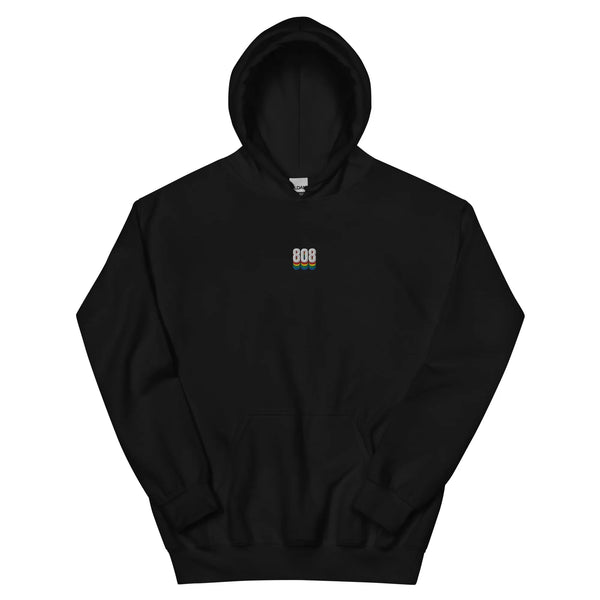
808 Music Producer Hoodie, embroidered

The 808 embroidered hoodie ($49.99) carries the number in thread on the chest, no loud print. It is a 50/50 cotton and polyester fleece at 271 gsm, a midweight, with a double-lined hood and a front pouch pocket. Black, navy, green, gray or white, sizes S to 2XL.
808 Is My Heartbeat Tee

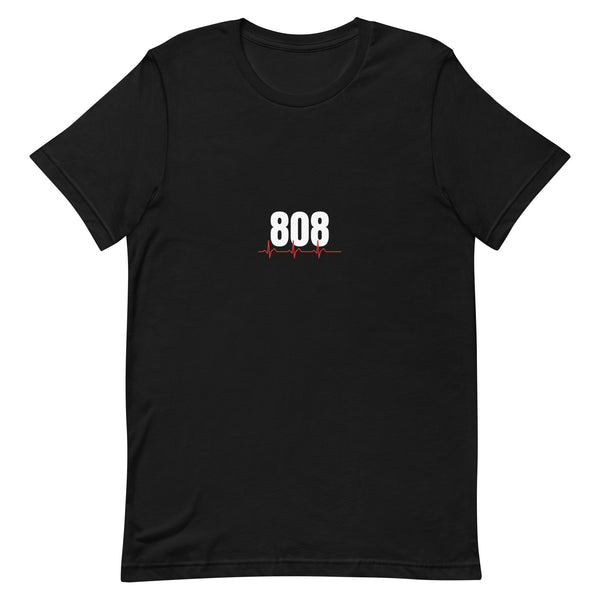
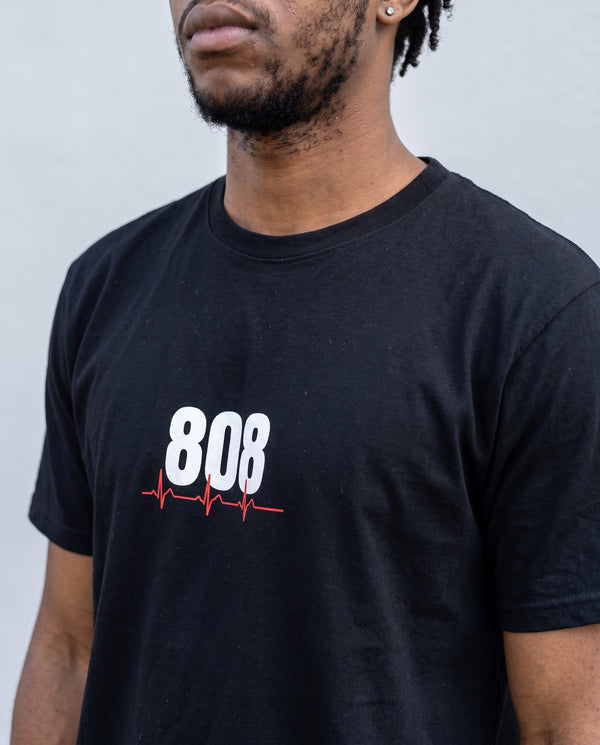
The 808 Is My Heartbeat tee ($34.99) is a bold 808 wordmark with a red heartbeat line through it, on a Bella + Canvas 3001 in combed ring-spun cotton (142 gsm, true to size). The rest of the line sits in our 808 collection.
Frequently Asked Questions
What BPM is trap music?
Trap runs anywhere from about 100 to 176 BPM, usually programmed in half-time, and a typical beat sits around 140 BPM, which feels like 70. 140 is the usual starting point, and seven of the eight patterns on this page use it. UK drill runs a little faster, roughly 138 to 151 BPM.
Where does the snare go in a trap beat?
On beat 3 of the bar, which is step 9 on a 16-step grid. Because the snare lands once per bar instead of on beats 2 and 4, a 140 BPM beat feels like 70. Ghost snares and short rolls go around it, never instead of it.
How do you make trap hi-hat rolls?
Set the grid finer than 1/16, then fill one or two steps right before the snare or at the end of the bar with 1/32 or 1/64 notes. Ramp the velocity up across the roll so it builds instead of buzzing, and keep the rest of the hat line simple.
Are these trap MIDI files free?
Yes. They are our own patterns, free to use in your own beats and royalty-free. All eight files download directly from this page with no email or sign-up. Use them as a starting point, then change the kick placement and the rolls so the pattern becomes yours.
Do the MIDI files work in FL Studio and Ableton Live?
Yes. They are standard MIDI files (type 1, 480 PPQ) with drums on General MIDI channel 10: kick 36, snare 38, clap 39, closed hat 42, open hat 46. Any DAW that opens .mid files can read them; point each note at your own drum sounds.
What is the difference between trap and drill drums?
Both use half-time snares around 140 BPM and sliding 808s. Drill hats tend to follow a 3+3+2 grouping rather than straight 16ths and triplets, and UK drill moves the snare later in the bar every second bar. Pattern 7 on this page is a one-bar starting point for that feel.
Wear it
The pieces this guide is built around. Every one ships free, no minimum.