
The Roland TR-808: How One Drum Machine Built American Hip-Hop

You have heard it ten thousand times. In the trunk of a car three lanes over. In the chest-rattling low end of a trap record. In the boom that announces a beat before a single word is rapped. You have heard the 808. You just might not have known its name, or that it came from a beige metal box that Roland gave up on more than forty years ago.
This is the story of the Roland TR-808: the drum machine that failed on arrival, got dumped into bargain bins, and then quietly rebuilt the sound of American music from the Bronx to Atlanta. It is the most important instrument in hip-hop, and one of the most influential in the history of recorded sound. Here is how a commercial flop became a culture.

Four decades after Roland gave up on it, the 808 still runs the room.
"It’s kind of like milk, or water. You cannot make a record without having that 808 sound."
Hank Shocklee, producer with The Bomb Squad (Public Enemy), via Rolling Stone
Wear the machine
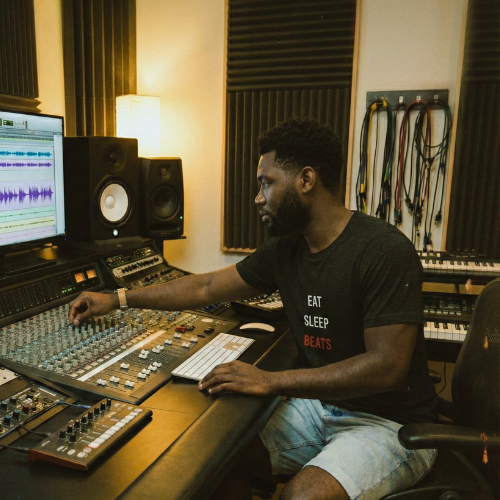
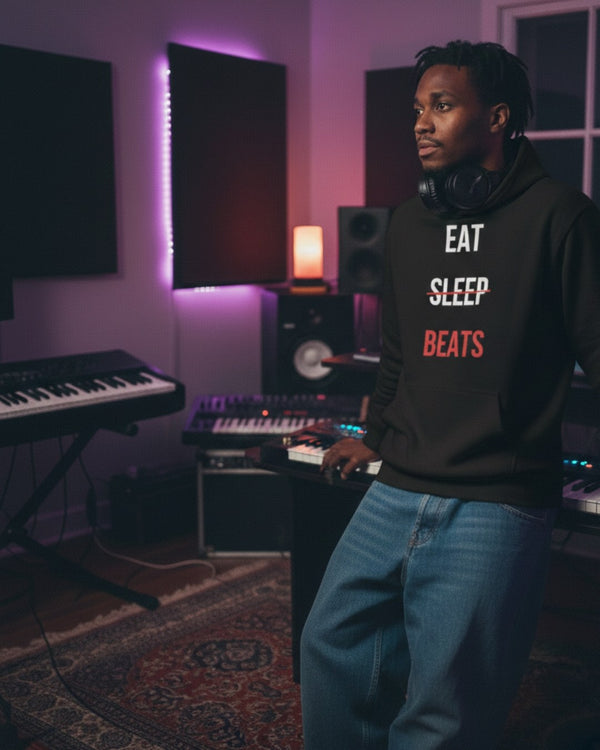
Four pieces built around the drum machine below, from the embroidered hoodie to the beanie. Pick a color and size and add straight to cart.


Swipe for more →
View cart →What Is an 808, Exactly?
Ask a producer today what an "808" is and they will not point at a machine. They will hum a bassline. Somewhere along the way, "the 808" stopped meaning a piece of hardware and started meaning a sound: that deep, tuned, sub-heavy kick drum that doubles as the bass of a song.
Both meanings are correct. The original 808, full name the Roland TR-808 Rhythm Composer, was a programmable drum machine released in 1980. Unlike the samplers that came after it, it did not record real drums. It synthesized them from scratch using analog circuitry, which is exactly why it sounds like nothing in nature: the snappy electronic snare, the metallic cowbell, the sizzling hi-hats, the hand-clap, and above all that long, booming bass drum. Producers discovered that if you tuned the bass drum's decay all the way out, it stopped being a "kick" and became a melodic bass note. Drum as bassline: that one trick is the entire foundation of modern hip-hop and trap.

Roland's TR-909, the 808's 1983 successor. It became the heartbeat of techno and house, but it was the 808 that hip-hop refused to put down.
The Anatomy of a Legend
Open up the 808's front panel and you are looking at a step sequencer: a row of buttons that light up to mark where each drum lands across a bar. You build a pattern by tapping in the steps, one voice at a time: bass drum here, snare there, a hat on every count. The machine loops it back instantly. It was hands-on, visual, and forgiving, which is part of why kids with no formal training took to it so fast. You did not need to read music. You needed an idea and a thumb.
Each of the 808's voices is a tiny analog circuit, not a recording. The bass drum is a tuned, sine-like thump you can stretch out into pure sub-bass. The snare is a burst of synthesized noise. The cowbell, instantly recognizable, is two square-wave tones clanging together. The handclap is a cluster of noise bursts engineered to imitate a room full of hands. None of it sounds "real," and that turned out to be the entire point: the 808 did not imitate a drummer, it invented a new kind of drummer that only existed inside the machine.
The Flop Heard Round the World
When Roland launched the TR-808 in 1980, the professional world shrugged. Musicians wanted drum machines that sounded like real drums, and the 808's synthetic claps and booming toms sounded, to trained ears, fake. Roland built the machine for only about three years. According to Smithsonian Magazine, fewer than 12,000 units were ever produced before Roland discontinued it in 1983, reportedly because the specific transistor that gave the 808 its dirty, characterful sound went out of production.
That should have been the end of it. Instead, the failure was the opening. As unsold and secondhand 808s flooded the market at cut-rate prices, they landed in exactly the hands that had no budget and no rulebook: the young producers building a brand-new genre in New York City. What sounded "fake" to a session drummer sounded like the future to a teenager making beats in the Bronx.
Why the "Worse" Machine Won
Here is the irony that makes the 808 story so instructive. By every measure the industry cared about, the 808 lost. Its main rival, the Linn LM-1 (and later the LinnDrum), used digital samples of actual drums, sounded far more convincing to professionals, and cost several times as much. The better, more expensive machine was supposed to win. It did not. The 808's synthetic, slightly-wrong sounds gave producers something the realistic machines never could: a signature you could not get any other way. You can always record a real drum. You cannot record an 808 kick — you can only make one with an 808. That scarcity of sound became its superpower.
The Man Behind the Machine
The 808 exists because of Ikutaro Kakehashi, the self-taught engineer who founded Roland in 1972 with a simple conviction: electronic instruments should be affordable, intuitive, and forgiving enough that anyone with an idea could use them. He chose synthesized voices over expensive digital samples partly to keep the price down, and he insisted on the hands-on step sequencer that made programming a beat feel like a game instead of an exam. Even the 808's famous sizzle traces back to his willingness to embrace imperfection: the machine's character came from cheap, slightly faulty transistors that Roland hand-selected for their noise, and when that part dried up, so did production.
Kakehashi never stopped shaping how music gets made. In 2013 he shared a Technical Grammy with Dave Smith for co-creating MIDI, the protocol that still lets studio gear talk to itself, as MusicRadar recounted in his obituary. He died in 2017 at 87, mourned by the same producers who had turned his commercial failure into the most influential drum machine on earth.
The Bronx Blueprint: "Planet Rock"
The 808's first world-changing moment came in 1982, when producer Arthur Baker, Afrika Bambaataa and the Soulsonic Force used it to build "Planet Rock." The track married the 808's alien percussion to a melody borrowed from Kraftwerk, and it did not sound like funk, disco, or rock. It sounded like a transmission from somewhere else, and it gave electro and hip-hop their first true anthem.
Pharrell Williams, reflecting on the record in the 2016 documentary 808, put it plainly:
"'Planet Rock' just did something else too. We never heard anything like that before."
Pharrell Williams
The Kick Becomes the Bass
What made the 808 stick was not novelty but utility. Producers realized the machine handed them a rhythm section and a bassline in a single box. Rick Rubin, who built foundational Def Jam records around it, has described the machine's particular magic:
"The rhythm of an 808 has its own internal groove."
Rick Rubin, in the documentary 808 (2016)
That internal groove is why so many landmark records lean on almost nothing else. Strip a song down to its frame and you can still ride an 808. Nowhere was that clearer than in the stripped-to-the-bone rap coming out of New York.
Run-DMC and the Sound of Pure Hip-Hop
In 1983, Run-DMC released "Sucker M.C.'s," little more than an 808 beat, scratches, and two MCs trading bars. No melody to hide behind, no live band, no disco polish. Just rhythm and rhymes. It was a declaration: this is what rap is now.
From there the machine spread through hip-hop's golden age: LL Cool J, Public Enemy, the Beastie Boys, the whole early Def Jam roster. But the 808's second life, the one that would make it permanent, was already taking shape a thousand miles to the south.
Bigger Than One Genre
It would be a mistake to think the 808 belonged only to rap. In 1982, the same year as "Planet Rock," Marvin Gaye built "Sexual Healing" around the machine, and its gentle 808 groove carried one of the biggest R&B records of the decade. Pop and new-wave acts followed; the 808 was quietly everywhere. But it was hip-hop that claimed the machine as a birthright rather than a tool, and it was hip-hop that would carry it for the next forty years.
Miami, Memphis, and the Move South
In Miami, the 808's booming low end found a natural home in Miami bass, music engineered almost literally for car subwoofers. In Memphis and New Orleans, producers like DJ Paul, Juicy J and Mannie Fresh leaned into the machine's menace and bounce. The center of gravity in American hip-hop was sliding toward the South, and the 808 was sliding right along with it.
The South Takes Over: Trap Is Built on the 808
By the late 2000s a new Southern sound had a name. Trap was 808 music in its purest form: rapid hi-hats, ominous melodies, and an 808 bass tuned and slid between notes until it carried the entire song. Shawty Redd and DJ Toomp laid the groundwork. Then a young Virginia producer named Lex Luger turned it into an avalanche, building the thunderous beats of Waka Flocka Flame's 2010 album Flockaveli. "Hard in da Paint" is a master class in how far the 808's bloodline can go.
What exactly is that modern 808? Less a drum than a bass guitar made of a single note. Producers tune it to the key of the song, then slide it between pitches (a quick glide from one note to the next) so one 808 carries the bassline, the rhythm and a surprising amount of the melody all at once. Add a layer of distortion so it punches through phone speakers, and you have the engine of nearly every chart-topping rap record of the last fifteen years. The software people build that engine with today is sorted by production stage in the best plugins for trap music.
The 808 as Default: Kanye, Metro, and Everything After
In 2008, Kanye West made the machine the literal title of an album, 808s & Heartbreak, and used its cold, synthetic boom to score heartbreak instead of bravado. It reset what a rap record could be about, and it confirmed the 808 as an emotional instrument, not just a rhythmic one.
The generation that followed grew up with the 808 as the default, not the exception: Metro Boomin, Mike Will Made-It, Zaytoven and dozens more. Today the sound lives inside laptops as much as hardware: a sampled, re-synthesized, infinitely tunable sub-bass that anchors a staggering share of the songs on the chart. The machine Roland could not sell is now, in software form, in nearly every studio on earth.
Why "808" Still Means Something
The number is shorthand now. "Put the 808 on it." "That 808 is knocking." It is the rare piece of studio gear whose name escaped the studio and became cultural slang, a badge for anyone who makes the beats, rides the low end, or simply loves the sound of it. As Roland itself has acknowledged, few instruments have shaped a culture this completely; its impact has been compared to what the electric guitar did for rock.
The reverence runs deep enough that the machine has its own holiday: every August 8th (8/08), producers, brands and Roland itself celebrate "808 Day."
That is why "808" is never just a number to the people who live this music. It is identity. Why a drum sound became a badge rather than just a preset is the argument in 808 culture and why the sound defines modern music.
Housekeeping note: we make an embroidered 808 hoodie for the people who live this sound, and it now sits in a full collection of 808 hoodies, tees and beanies. That's the whole sales pitch in this article, and it's over now.
The 808 Timeline: 1980 to Today
- 1980: Roland releases the TR-808 Rhythm Composer at about $1,200. Critics call the sounds unrealistic and sales disappoint.
- 1982: "Planet Rock" and "Sexual Healing" put the machine on the dancefloor and the radio in the same year.
- 1983: Roland discontinues the 808 after roughly 12,000 units; Run-DMC's "Sucker M.C.'s" strips rap down to the machine and two mics.
- Late 1980s: Miami bass turns the 808 kick into subwoofer culture and the South adopts the machine for good.
- 2008: Kanye West's 808s & Heartbreak makes the machine the emotional center of a blockbuster album.
- 2010: Lex Luger's beats for Flockaveli lock the modern trap 808 template in place.
- 2014–2018: Roland revives the sound in hardware with the TR-8, TR-08 and TR-8S, and the documentary 808 (2016) canonizes the story.
- Today: The 808 lives in every DAW as tunable sub-bass, and producers celebrate 808 Day every August 8th.
One practical note for anyone building tracks on these sounds. The 808 kick sits in the same space as the bass because it is the bass, which is what makes 808-heavy records hard to master: push for volume and the low end starts eating the rest of the mix. We build a mastering processor for that problem, and the rest of the line is on the plugins page.

Mastering · $29
Ghostnote MONOLITH
Play the song once, end to end, and it hits your LUFS target with the dynamics intact. Asked for −14 in our probe suite, it settled within 0.1 LU. It runs offline with nothing uploaded, and it is not a neural net.
See MONOLITH →Frequently Asked Questions
What is an 808?
An 808 is the Roland TR-808 drum machine, released in 1980. In modern slang, it is also the deep, tuned sub-bass kick drum the machine became famous for. Producers tune the 808's bass drum so it acts as both the kick and the bassline of a song, which is why "808" now usually refers to that booming low-end sound.
Who invented the 808?
The Roland TR-808 was created by the Japanese company Roland, under founder Ikutaro Kakehashi, and released in 1980. Roland produced it until 1983.
Why is it called the 808?
The name simply comes from the machine's model number, the Roland TR-808. It stuck so hard that producers now use "808" to describe the sound itself.
What songs use the 808?
Thousands. Landmark American examples include Afrika Bambaataa's "Planet Rock" (1982), Marvin Gaye's "Sexual Healing" (1982), Run-DMC's early records, Kanye West's entire 808s & Heartbreak album, and essentially the whole of modern trap.
Is the TR-808 still made today?
Original units stopped production in 1983 and now sell for thousands on the used market. Roland makes modern recreations (the TR-8S and the compact TR-08), and every major DAW ships with sampled or synthesized 808s, so the sound itself has never been easier to get.
Sources & Further Reading
- Smithsonian Magazine: The TR-808 Drum Machine Changed the Sound of Pop Music Forever
- Roland: Retracing the Roland Sound in Hip-Hop
- Rolling Stone: Phil Collins, Rick Rubin, Pharrell Extol '808' in New Doc
- Native Instruments: Legendary Beats Featuring Huge 808s
- 808 (2016), documentary directed by Alexander Dunn
- MusicRadar: Ikutaro Kakehashi, founder of Roland and creator of the TR-808, dies at 87
- LANDR: A Brief History of the Roland TR-808
Take VEIL with you
The de-esser this site was built around. Free, keyless, yours on every machine you own.
A copy goes to your inbox. Unsubscribe anytime.
VEIL is yours. Pick your build.