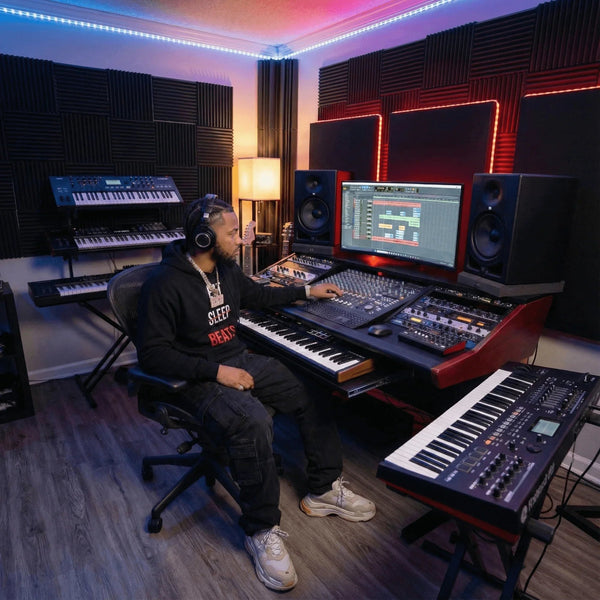

Best Plugins for Trap Music (2026): 808s, Vocals and Mix
The plugins trap needs by production stage, from 808 saturation to the master, with a free pick and a starting setting for each.

Best plugins for trap, by stage: Xfer Serum for 808s and leads, Kontakt for sampled drums, FabFilter Pro-Q for surgical EQ, a Valhalla reverb for space, a fast compressor plus a split-band de-esser for vocals, and a loudness meter for the master. There is a free pick for every stage. Sort by stage, not brand: most trap beats fall apart at the mix end, not the synth.
Disclosure: we make audio plugins. Two of ours appear in one labeled section near the end; every other pick is somebody else's. No affiliate links, no sponsorship, so nothing on this page pays us.
Reviewed July 2026. Prices and versions change, so check the developer's page before buying.
Get VEIL free
Our de-esser for rap vocals. Free, keyless, no account. Enter an email and the download appears right here.
A copy goes to your inbox. Unsubscribe anytime.
VEIL is yours. Pick your build.
The short list, by production stage
| Stage | The job | Pick |
|---|---|---|
| 808s and bass | Clean sine, pitched attack, glide, in key | Xfer Serum |
| 808 translation | Harmonics so the note reads on small speakers | Any saturator or clipper you know well |
| Drums and percussion | Load one-shots, tune them, shape transients | Kontakt, or your DAW's stock sampler |
| Melody and texture | Plucks, bells, dark keys, sampled instruments | Serum, Kontakt libraries |
| Surgical EQ | See a resonance, cut it, mono the lows | FabFilter Pro-Q |
| Vocal dynamics | Catch peaks fast, then level the phrase | A FET-style compressor and a slow leveler |
| Vocal pitch | Tune hooks and ad-libs without warble | Antares or Celemony, by job |
| Space | Tails and throws that sit behind the vocal | Valhalla reverbs |
| Metering and master | Integrated LUFS, true peak, width | A loudness meter plus one limiter |
Why do most trap beats sound unfinished?
Not the synth. It is a sub that vanishes on a phone, hats that shred at volume, and a vocal buried under an 808. Trap arrangements are sparse, sometimes only five elements, so a mediocre snare that would hide under guitars in a rock mix sits exposed here. Processing matters more than plugin count, which is why a brand-sorted list sends you shopping instead of mixing.
What are the best plugins for 808s and bass?
One synth that makes a clean sine with a fast pitch envelope on the attack, plus something that adds harmonics. Xfer Serum is the standard pick because it also covers leads and plucks, but any subtractive synth with glide builds an 808, and a sampled one-shot works too.
Tuning is the part people skip. An 808 is a pitched instrument: F1 sits at roughly 43.7 Hz, G1 at 49 Hz, A1 at 55 Hz. Pitch a one-shot by ear and the sub fights the melody in a way that reads as "muddy" rather than "out of tune." Find the key first, then program the bassline.
Then the harmonics. A phone speaker cannot move enough air to reproduce a 45 Hz fundamental, so listeners hear the harmonics above it and the ear supplies the missing note. That effect, the missing fundamental, is why a saturated 808 translates. Saturation and clipping generate those harmonics: drive a duplicate of the 808 into a saturator and blend it under the clean one, or clip in series before the limiter. Set the amount on a laptop speaker, then back it off a little.
The 808 is the load-bearing sound of modern rap, which is also why it gets over-processed. Layering is the usual culprit: two 808s at the same octave can partly cancel and leave you with less low end than one.
| Move | Starting value | Why |
|---|---|---|
| Subsonic filter on the 808 | 20–30 Hz, 24 dB/oct | Energy no speaker reproduces, but the limiter still pays for it |
| High-pass everything else | 100–150 Hz on keys, pads, hats | Clears the 808's lane, so it needs less level |
| Mono below | 100–120 Hz | Stereo bass wastes headroom and folds down badly |
| Kick against 808 | Duck 2–4 dB, 10 ms attack, 80–120 ms release | Passes the kick transient without gapping the sub |
| Glide for slides | 40–90 ms | Long enough to hear, short enough to stay in time |
| True-peak ceiling | −1.0 dBTP | Saturated bass creates inter-sample peaks that encoders clip |
What are the best plugins for trap drums and percussion?
A sampler and a transient shaper cover it. Native Instruments Kontakt is the paid pick for its library ecosystem, not because a stock sampler cannot load a one-shot. For hats, claps and snares, stock is fine and faster. If you need patterns to drop those one-shots into, our trap drum patterns come as eight step grids with MIDI downloads.
What earns a slot is transient control. Trap kits get compressed and saturated on the bus, which softens attacks; a transient shaper puts the click back without adding level. On hats, vary velocity and pitch slightly so rolls read as performed rather than pasted. Tune the open hat if it collides with the melody.
On layered claps and snares, high-pass the clap around 300 Hz and keep the snare's body. Offsetting one a few milliseconds widens the pair and comb-filters where they overlap, so check in mono. Skip reverb on the whole kit: a short room on the snare beats a global send.
What plugins do you need for trap melodies and sampling?
Serum and Kontakt again, plus a source of material. Splice is a practical loop and one-shot library, with the caveat that a loop everybody has is a loop everybody has.
The processing that makes a melody sit behind a rap vocal is subtractive. High-pass the loop, then carve a dip where the vocal lives, roughly 1–3 kHz, on FabFilter Pro-Q or a free dynamic EQ. Dynamic is better: the dip only needs to exist while the vocal speaks.
For space, Valhalla DSP covers plate to cavern and Supermassive is free. High-pass the reverb return at 300 Hz so the tail stays out of the 808's lane.
What plugins do trap vocals need?
Five jobs, in this order: pitch, de-essing, two stages of compression, color, one space. Most trap plugin lists cover the synths and stop. The vocal is what the listener follows.
| Job | Kind of tool | Starting point |
|---|---|---|
| Pitch | Realtime tuner; an offline note editor for repairs | Key and scale set first, then the least correction that holds the note |
| De-essing | Split-band de-esser, ahead of the compressor | Crossover 5–8 kHz, 3–6 dB of reduction, high band only |
| Peak control | Fast FET-style compressor | Ratio 4:1, attack near 1 ms, release 110 ms, sidechain high-passed 80–120 Hz |
| Leveling | Slower optical-style compressor | Ratio 2.5:1, attack 25 ms, release 220 ms, 2–6 dB total across both stages |
| Color | Saturation, tube through tape | Set on a level-matched bypass so you judge character, not volume |
| Space | One reverb and one delay, on sends | Predelay 20–40 ms, return high-passed at 300 Hz, ridden onto line ends |
Pitch. Auburn Sounds Graillon has a free edition that handles realtime tuning. Antares makes the product most people mean by autotune, and Celemony's Melodyne is the offline note editor for fixing a take rather than styling one. Set key and scale first; in my sessions, a wrong scale is the most common cause of a warbling hook.
De-essing. Rap delivery plus a bright condenser plus saturation equals sibilance that stabs. A split-band de-esser puts the reduction on the high band only; a broadband one turns the whole voice down every time an "s" arrives, which is what people mean when de-essing dulls a vocal.
Compression. Two light stages beat one heavy one: a fast compressor for consonant peaks, then a slower one to level the phrase. High-pass the sidechain detector, otherwise 808 bleed and plosives drive gain reduction that has nothing to do with the words. The first time I heard a vocal compressor pumping in time with the beat, the fix was a high-pass on its detector, not a different plugin. The order every stage sits in is in our rap vocal chain in order, and numbers by delivery style are in our vocal compression settings for rap.
Space. Dry in the verses, wet on the throws, with the delay automated rather than left open.
What plugins do you need to mix and master a trap beat?
An EQ you can see, a stereo tool, a loudness meter, one limiter. Pro-Q or TDR Nova handles surgical work, iZotope Ozone Imager is free and shows width and correlation, and Voxengo SPAN plus Youlean Loudness Meter tell you where you landed.
Loudness is where trap producers do the most damage. Platforms normalize playback: Spotify's documentation describes normalizing to −14 LUFS, and Apple Digital Masters asks for headroom so the encode does not clip. Push a master to −6 LUFS and you buy density, pay in transient life, and the listener still hears it at the platform's target. Trap tends to sit hotter than the −14 folklore, since dense 808 energy and a short dynamic range go with the genre, so pick a target on purpose. I leave most trap masters between −10 and −8 LUFS integrated against a −1.0 dBTP ceiling. The platform-by-platform argument is in how loud should a rap master be.
Measure with a meter that implements the standard, not a peak meter. Integrated loudness is defined in ITU-R BS.1770 and applied in EBU R128; both gate and integrate across a whole program rather than a loop. Ian Shepherd at Production Advice has argued for years that once playback is normalized, extra limiting costs dynamics without buying loudness. The full process is in how to master a rap song at home.
Can you make trap with only free plugins?
Yes, and sparse arrangements help: fewer elements, fewer plugins that have to be excellent. Here is a free chain for every stage, catch included.
| Stage | Free pick | The catch |
|---|---|---|
| 808s, leads | Vital | Free tier is a working synth; extra content is paid |
| Melody, texture | Surge XT | Open source, no tiers, but the interface rewards patience |
| EQ, de-essing | TDR Nova | A dynamic EQ, not a dedicated de-esser, so you set the band and detector yourself |
| Leveling | TDR Kotelnikov | Colorless by design; the Gentleman's Edition extras are paid |
| Character compression | Analog Obsession range | Patreon-funded, so update pace depends on that |
| Pitch | Graillon free edition | Covers core correction; the paid edition adds the rest of the feature set |
| Space | Valhalla Supermassive | Built for long tails, not a natural small room |
| Metering | SPAN, Youlean, Ozone Imager | Youlean's free tier is limited; Ozone Imager needs an account |
Download from the developer's own domain. Aggregator sites repackage installers, and cracked builds are a known route for malware onto a studio machine.
What trap plugins should you skip?
Preset packs sold as a sound. Twenty-gigabyte libraries bought before you can finish a beat. A mastering suite bought before you can balance a mix. A second reverb before you know the first one's decay knob by feel. Producers whose beats translate own fewer plugins than you would guess and know each one cold.
From Our Own Line
Two of ours belong in a trap conversation, both for reasons that come down to bass.

Vocal compressor + saturator · $29
Ghostnote TALISMAN
Two compressor stages in series feeding tube-to-tape colour. Pick a preset and turn DRIVE, or open the ADVANCED panel and set both stages yourself, sidechain high-pass included.
See TALISMAN →TALISMAN ($29) is a vocal compressor and saturator. What keeps it usable on 808-heavy material is the sidechain filter. Feed a full-band detector a trap loop and it pumps in time with the bass. Open its ADVANCED panel and TALISMAN high-passes the sidechain into both detectors, 80 Hz by default and adjustable from 20 to 500 Hz: in our probe suite, a 60 Hz tone drew 26.3 dB of gain reduction with that filter at 20 Hz and 11.2 dB with it at 500 Hz. That is the difference between a compressor that follows the vocal and one that follows the sub, and it is why it also holds up on a drum bus or across an 808 and kick.
Two stages run in series. GRIT is the FET-style one: an instant peak detector, a 4 dB knee and a program-dependent ratio rise, so sustained input pushes the ratio up instead of holding one fixed slope. WARMTH is the optical-style stage: RMS detection, a soft 9 dB knee, low ratios. The vocal table above uses those defaults, and 2–6 dB of gain reduction is the sweet spot on rap phrases. Saturation morphs tube to tape at 4× oversampling, and AUTO matches output RMS to input inside a ±12 dB window, so drive adds character rather than loudness.

Mastering · $29
Ghostnote MONOLITH
Play the song once, end to end, and it hits your LUFS target with the dynamics intact. Asked for −14 in our probe suite, it settled within 0.1 LU. It runs offline with nothing uploaded, and it is not a neural net.
See MONOLITH →MONOLITH ($29) masters the whole song rather than a loop. Its loudness engine is full ITU-R BS.1770-4 and EBU R128, with integrated LUFS accuracy of ±0.03 LU at 44.1, 48 and 96 kHz. Asked for −14 LUFS in our probe suite, it settled within 0.1 LU. True peak follows BS.1770-4 Annex 2 at 8× oversampling, worst case −2.26 dBTP against a −1.0 dBTP ceiling, re-measured 16 times. Targets are −14, −12, −10, −9, −8 and −7 LUFS, default −10.
Two details matter for trap. Lows below 120 Hz are always summed to mono, with a 24 Hz subsonic high-pass on by default. The four-band corrective EQ (bass 50–120 Hz, mud 200–400 Hz, presence 2.5–5 kHz, air 9–15 kHz) halves every move and caps it at ±3–4 dB, so a dense beat does not get re-voiced. The plugin is not a neural net: it measures, then applies one gain trim and one conservative tonal move, offline, with nothing uploaded.
One lesson worth passing on: measuring the chain at unity overshot the target by about 1.5 dB on hot material, because glue and limiting are level-dependent. MONOLITH now trims mid-capture and measures near final operating level.
Both are VST3 on macOS and Windows, AU on macOS, keyless, with no license server or machine limit. Instant download, digital sales final. The rest of the line sits on the Ghostnote plugins page.
Frequently Asked Questions
What plugins do most trap producers use?
A wavetable synth, a sampler, one EQ, one compressor, one reverb, a limiter and a loudness meter. Serum, Kontakt, Pro-Q and a Valhalla reverb come up constantly, but the tools vary less than the habits: tuned 808s, saturation for phone playback, mono lows and a measured master.
What is the best plugin for making 808s?
Any synth with a clean sine, a fast pitch envelope on the attack and glide. Serum is the common answer because it also covers leads and plucks, and a sampled 808 one-shot works as well. Tuning to the key and adding harmonics matters more than the plugin.
Do you need Serum to make trap?
No. Serum earns its reputation on wavetable editing and modulation depth for melodic parts, not on bass duties any synth can perform. Vital and Surge XT are free and will build the same kind of 808. Spend the money on a sampler library or a loudness meter first.
Why does my 808 disappear on phone speakers?
Because a phone driver cannot reproduce a 45 Hz fundamental, so listeners hear only the harmonics above it. Add saturation or clipping to generate those harmonics, keep everything below 120 Hz in mono, and high-pass keys, pads and hats out of the 808's lane.
How loud should a trap master be?
Aim between −10 and −8 LUFS integrated with a true-peak ceiling around −1.0 dBTP. Trap runs hotter than the −14 LUFS Spotify normalizes to, but extra loudness buys density rather than volume and costs transient life. Pick a target, measure the whole song rather than a loop, and stop there.
Take VEIL with you
The de-esser this site was built around. Free, keyless, yours on every machine you own.
A copy goes to your inbox. Unsubscribe anytime.
VEIL is yours. Pick your build.