
Reverb and Delay Settings for Rap Vocals
Pre-delay, decay, return filters and tempo-synced delay times for rap vocals, why both belong on sends, and how to stop reverb washing out a fast flow.

Put both on sends. Start the reverb on a plate or short room at 0.8 to 1.2 s of decay with 20 to 40 ms of pre-delay, the return high-passed at 300 to 500 Hz and low-passed at 6 to 8 kHz. Start the delay on a dotted eighth with feedback at 20 to 30 percent, filtered a little darker: high-pass around 500 Hz, low-pass around 5 kHz. Then duck both returns 3 to 6 dB under the dry vocal, so the space lives in the gaps and disappears under the words.
Disclosure: Ghostnote makes audio plugins and one of them is a reverb. It gets one labeled section near the end, and the numbers credited to it are control ranges and measurements published in its manual, marked as ours. Everything else here works in the reverb and delay your DAW already ships with. No affiliate links.
Get VEIL free
Our de-esser for rap vocals. Free, keyless, no account. Enter an email and the download appears right here.
A copy goes to your inbox. Unsubscribe anytime.
Or go further with Ghostnote SEANCE ($29.00).
VEIL is yours. Pick your build.
Why do reverb and delay belong on sends and not inserts?
An insert puts the processor inside the vocal's signal path, so everything downstream treats the tail as if it were the voice. The bus compressor's detector now reads reverb. The saturator generates harmonics from reverb. The master limiter spends headroom on reverb. A send splits a copy off to a return channel instead, and the dry vocal reaches the bus untouched.
Three practical things follow from that, and they are the reason this is not a matter of taste:
- You can process the wet alone. A 6 dB cut at 400 Hz is invisible on a reverb return and obvious on a vocal. So is 8 dB of de-essing. The return is where you are allowed to be heavy-handed.
- Several tracks can share one space. Lead, doubles and ad-libs feeding one plate sit in the same room. Give each its own insert and you have built three rooms that do not agree with each other.
- You can automate the effect without touching the vocal. Throws, bigger hooks and drier verses are all send moves, and none of them change the level of the voice.
There is one case where an insert is correct: when the wet signal is the part. A hard-tuned hook printed with its delay baked in, or a single ad-lib bounced as its own clip, is a performance rather than an effect. Print it and mix it like any other track.
Set the sends post-fader, which is the usual default. A post-fader send scales with the channel fader, so pulling the vocal down in a breakdown takes its room with it. A pre-fader send holds the tail at full level while the dry vocal drops, which reads as the vocal falling into a hole. That is occasionally the effect you want, and never the one you want by accident.
Placement in the chain: after tonal EQ, which makes this the last move on the vocal itself before the vocal bus. The full stage order is in the rap vocal chain in order, and the EQ stage that feeds this one is in EQ settings for rap vocals.
What reverb settings should you start with on a rap vocal?
Four sends cover everything a rap vocal asks for. Most mixes only need two. Build send A and send D first, add B when a hook needs a moment to hang, and add C only when the doubles need width that panning is not giving them.
| Send | Type | Time | Pre-delay | Return filters | Ducking | Fed by |
|---|---|---|---|---|---|---|
| A | Short plate or room | 0.6–1.2 s | 20–40 ms | HPF 400 Hz, LPF 7 kHz | 3–5 dB | Lead and doubles, always on |
| B | Long throw hall | 1.8–3 s | 40–60 ms | HPF 500 Hz, LPF 6 kHz | 5–8 dB | One word per four bars, automated |
| C | Slapback | 60–120 ms, one repeat | n/a | HPF 400 Hz, LPF 5 kHz | 2–4 dB | Doubles and ad-libs |
| D | Tempo delay | Dotted 1/8, feedback 20–30% | n/a | HPF 500 Hz, LPF 5 kHz | 4–6 dB | Hook tails and ad-libs |
Set the send amount last, and set it by muting rather than by soloing. Mute the return: if the vocal changes size, the send is right. If it changes level, the send is too loud and you are using reverb as a fader. On a dense verse the right amount is usually less than it feels like while you are setting it, because you are listening to the return and the listener never will.
Algorithmic plates and rooms are the default here rather than convolution. An algorithmic reverb computes its tail from delay lines and the settings you give it; a convolution reverb combines the vocal with an impulse response recorded in one space (Apple's overview of reverb types). The table is written for the first kind. Much of that delay-line design traces back to Manfred Schroeder of Bell Labs, who presented Natural Sounding Artificial Reverberation to the AES in 1961 and published it in the Journal the following year. It describes parallel comb filters feeding series allpasses, and a nested allpass design. Valhalla DSP's walkthrough calls that second idea, allpasses inside feedback loops, fundamental to the algorithms of Lexicon and Alesis.
The stock plugins in Logic and Live cover every control those four sends use. Logic's ChromaVerb has predelay and decay, both of which can sync to tempo (Logic Pro User Guide), and Live's Reverb has predelay, decay and low and high cut filters (Ableton Live audio effect reference). Both DAWs also ship a tempo-synced delay with feedback and filtering, and a compressor with a sidechain input for the ducking. Valhalla gives Supermassive away if you want a stranger set of tails.
What does pre-delay do, and why 20 to 60 ms?
Pre-delay is the gap between the dry word and the first wet arrival. Set to zero, the reverb starts on the consonant. Set to 30 ms, the consonant's attack is already out when the room turns up.
The hearing research behind this is well covered. The first-arriving wavefront dominates where a sound is heard to be, and later copies inside a certain window fuse into it rather than reading as separate events, a body of work reviewed by Litovsky, Colburn, Yost and Guzman in the Journal of the Acoustical Society of America. The size of that window depends on the material: echo thresholds run from roughly 5 to 10 ms for clicks to upward of 50 ms for music and speech, figures gathered from studies going back to 1949 in more recent work on auditory object formation.
That puts 20 to 60 ms in a useful place. It is late enough that the attack of every word reaches the listener before any wet energy does, and close enough to the fusion window that the tail still belongs to the voice instead of announcing itself as a separate sound. Intelligibility survives and the vocal still sits in a space.
- 20 to 30 ms. Laid-back deliveries and melodic hooks, where the consonants are not the whole story.
- 30 to 40 ms. The default on a verse. Sixteenth-note flows want the top of this range.
- 40 to 60 ms. Long throws and big hooks, where a longer gap keeps a 2 s tail from stepping on the word that launched it.
- Above 60 ms. On a fast flow the tail of one word now starts on top of the next. You have stopped making space and started making a second rhythm.
Setting it by ear takes thirty seconds. With the vocal and the return both playing, raise pre-delay until the reverb starts to sound like a separate echo of the word, then back off about 5 ms. Apple's ChromaVerb documentation gives the same method: the longest predelay you can use before you hear an audible echo, then slightly less.
If your reverb syncs pre-delay to tempo, a thirty-second note is a good target: at 140 BPM that is 53.6 ms, right in the window. A sixteenth at the same tempo is 107 ms, which is past it.
How long should the reverb decay be for rap?
Short. Start at 0.8 to 1.2 s on the always-on send, and reach past 1.5 s only for hooks and throws. The reason is arithmetic rather than fashion.
A quarter note in milliseconds is 60000 divided by the tempo, so at 140 BPM a sixteenth note lands every 107 ms. A 2.0 s tail is therefore still sounding roughly 19 sixteenth notes after the syllable that caused it. A 0.8 s tail covers about 7. Rap carries its information at the syllable rate, and every overlapping tail is energy sitting on top of a syllable the listener has not decoded yet.
Room acoustics has been putting numbers on this for decades. ANSI S12.60, the American classroom-acoustics standard, caps reverberation time at 0.6 s for classrooms under 10,000 cubic feet and 0.7 s up to 20,000, alongside a 35 dBA background noise limit, with speech intelligibility as the goal. A mix is not a classroom and a plate was never a room, so do not copy the number across. Do notice which direction it points.
| Decay | Sixteenths of overlap at 140 BPM | Where it belongs |
|---|---|---|
| 0.4 s | About 4 | Ambience under a rapid-fire verse, almost inaudible on its own |
| 0.8 s | About 7 | The default verse plate |
| 1.2 s | About 11 | Laid-back delivery, half-time feel |
| 1.8 s | About 17 | Sung hook with space between phrases |
| 3.0 s | About 28 | Throws only, on a send that is at zero the rest of the time |
Automate the decay rather than compromising on it. A verse plate at 0.8 s and a hook hall at 2 s, switched by the arrangement, beats a 1.4 s reverb that is wrong in both places.
Where do you filter the reverb return?
High-pass the return at 300 to 500 Hz and low-pass it at 6 to 8 kHz. Both filters go on the return channel, after the reverb, so they shape everything feeding that send. If one track needs a darker tail than the rest, give it its own send rather than filtering the shared one twice.
The high-pass first, because it is the one that fixes mixes. Everything the return carries below 300 Hz is the low-mid body of the voice smeared across the whole tail length, and none of it tells the listener anything. Left in, it sits exactly where the 808 and the kick need room, and it is the difference between a vocal that sounds big and a mix that sounds cloudy. At 500 Hz the fog is gone and the tail still reads as space.
The low-pass next. You spent a de-esser and a tonal EQ deciding how bright this vocal should be, and an unfiltered tail hands that decision back, smeared over half a second. Roll off at 6 to 8 kHz and the tail sits further back behind the voice.
Then de-ess the send itself, 4 to 8 dB, far harder than you would ever de-ess the vocal. Nobody listens to a reverb tail for its consonants, and an unmanaged ess splashed across a 1 s tail can make a vocal sound harsh at a send level that measures modest. The method is in de-esser settings for rap.
Two more moves the return will forgive and the vocal will not: a wide 3 to 6 dB cut wherever the tail rings, and a narrow notch on any resonance the reverb exaggerates. Cuts that would be obvious on the dry track are hard to hear on a signal nobody listens to directly.
What delay time should you use, and how do you work it out?
Start from the arithmetic, then pick the note value by the flow rather than by the drums.
A quarter note in milliseconds is 60000 divided by the tempo. Halve it for an eighth, quarter it for a sixteenth, multiply the eighth by 1.5 for a dotted eighth, and divide the quarter by 3 for a triplet eighth.
| Tempo | 1/4 | Dotted 1/8 | 1/8 | Triplet 1/8 | 1/16 |
|---|---|---|---|---|---|
| 80 BPM | 750.0 ms | 562.5 ms | 375.0 ms | 250.0 ms | 187.5 ms |
| 90 BPM | 666.7 ms | 500.0 ms | 333.3 ms | 222.2 ms | 166.7 ms |
| 120 BPM | 500.0 ms | 375.0 ms | 250.0 ms | 166.7 ms | 125.0 ms |
| 140 BPM | 428.6 ms | 321.4 ms | 214.3 ms | 142.9 ms | 107.1 ms |
| 160 BPM | 375.0 ms | 281.3 ms | 187.5 ms | 125.0 ms | 93.8 ms |
Which value to reach for:
- Dotted eighth. The rap default. It lands between the beats, so each repeat fills the gap the vocal left instead of arriving on the next beat, where the kick or snare already is. At 140 BPM that is 321.4 ms.
- Quarter. One repeat per beat, a wide spacing that still feels tied to the track. Best on half-time feels and on throws, where you want the repeat to be heard as an event.
- Eighth. Doubles the pulse. Clean under a half-time hook, busy under a sixteenth-note verse.
- Triplet eighth. Match the delay to a triplet flow, not to the drums. A dotted eighth against triplets fights the vocal every bar.
- Sixteenth. Rarely useful on a lead. At 140 BPM it is 107 ms, which is slapback territory, so it reads as a slap rather than as a rhythmic repeat. If a slap is what you want, build it as one: a single repeat, no feedback.
Then there is the half-time trap, which catches a lot of trap mixes. A beat written at 140 BPM with a half-time drum pattern feels like 70. The pulse the listener is tracking is the grid's half note, so a dotted eighth taken off the 140 grid lands like a dotted sixteenth against that felt pulse. Step everything up one value: at 140 half-time the dotted quarter, 642.9 ms, reads the way a dotted eighth reads at 70.
Feedback is where delays go wrong. At 20 to 30 percent you get two or three audible repeats and the line clears before the next one starts. At 35 to 50 percent you get a throw. Above 60 percent the arithmetic turns on you: each repeat is only 4.4 dB below the last, so it takes about 14 hops to fall 60 dB, and at a 321 ms dotted eighth that is roughly 4.5 seconds of tail, still ringing more than two bars later. In a dense verse the delay never clears and the mix accumulates a haze you cannot point at.
Two settings that make high feedback usable: a filter in the feedback loop, so each repeat is darker than the last and the ear stops tracking it sooner, and ping-pong, which keeps the repeats out of the center where the dry vocal lives. Logic's Tape Delay puts its high-pass and low-pass filters in the feedback loop, and Live's Delay has a filter and a Ping Pong switch. Soundtoys EchoBoy is a paid option when you want the repeats to have character of their own: its 30 echo styles are modeled on units such as the Echoplex and the Space Echo.
When is a slapback the right call?
A slapback is one repeat at 40 to 120 ms, no feedback, not synced to the grid. It solves a problem reverb cannot: width and thickness with no tail.
The range splits in two, and the echo-threshold figures above explain where. With the threshold for music and speech sitting at around 50 ms and above, a repeat under about 50 ms tends to fuse with the voice, so it reads as thickening and a shift in width rather than as a second sound. Push it further out and it separates, and you hear a slap.
- 40 to 55 ms. Thickening. Use it on doubles and on a lead that needs weight without space. It rarely reads as a delay.
- 60 to 120 ms. A slap you can hear. Classic on ad-libs, on hooks, and on any vocal sitting over a beat with enough low-mid content that a reverb would fog it.
Where it is wrong: on a lead in a dense sixteenth-note verse. With syllables 107 ms apart at 140 BPM and a 90 ms slap under them, the repeats interleave with the performance and the whole thing reads as a timing problem the rapper did not have.
Pan the slap opposite the dry vocal and it becomes the cheapest width in the mix. Check it in mono before you commit: summed to the center, the width disappears and what is left is an echo right behind the word.
How do you throw the last word of a bar?
The throw is what separates a mix that sounds mixed from one that sounds arranged, and it is a send automation move rather than a plugin setting.
- Build send B: the long hall, fed by a delay on a quarter or dotted eighth with feedback at 35 to 50 percent, or with that delay on a send of its own beside it.
- Leave the send at zero for the whole verse.
- Draw the automation up for the duration of one word, and back to zero before the next word starts. Draw it on the grid rather than riding it by hand, so the send closes cleanly.
- Check where the tail lands. If repeats are still sounding on the next downbeat, lower the feedback or shorten the delay by one note value.
Two rules keep throws from becoming wallpaper. One word per four bars, and only on a word worth repeating. A thrown filler word sends the listener's attention somewhere and gives it nothing when it arrives.
Good candidates: the last word of bar 4, 8 or 16; the last word before the hook; a single ad-lib you want to leave hanging over the drop. Bad candidates: every rhyme at the end of every bar, which is a quick way for a mix to sound like a first attempt.
If your DAW makes send automation painful, there is a version with no automation at all. Duplicate the vocal track, delete everything except the one word, and put the delay on that track as an insert. This is the case where an insert is correct, because on that track the wet signal is the whole point.
Should the returns duck under the dry vocal?
On a verse, yes. The effect should be audible in the gaps and inaudible under the words, and ducking is how you get both from one send level.
Put a compressor on the return with the dry vocal keyed into its sidechain. Ratio 4:1, attack 5 to 10 ms, release 200 to 300 ms, threshold set for 3 to 6 dB of gain reduction while the vocal is speaking. On a hook, back it off to 2 to 4 dB or switch it off.
Release is the control that decides whether it works. Too short and the tail jumps back up in every gap between syllables, which is audible as breathing and is worse than no ducking at all. Too slow and the tail never returns, at which point you have deleted the send by a complicated route. Tie it to the phrase rather than the syllable: at 140 BPM, 200 to 300 ms is roughly two to three sixteenth notes, long enough to ride through a word and short enough to open in a rest.
What ducking buys is headroom for the effect itself. You can run the send noticeably hotter than would be usable flat, because the tail only ever shows itself where nothing is competing with it. That is how a mix manages to sound both large and legible.
Two alternatives if a sidechain is awkward in your DAW: automate the return's fader down under the vocal and up in the gaps, which is more work and more precise, or use a reverb with ducking built into it, which needs no routing at all.
Why does reverb wash out a fast flow?
Because a fast flow leaves no gaps for the tail to sit in, so every millisecond of it lands on top of the next syllable. At 140 BPM with sixteenth-note delivery, a 1.8 s hall is still sounding roughly 17 syllables later. The vocal is not quiet and the reverb is not loud. There is simply nowhere for the tail to go.
Work through these in order, and stop when it is fixed:
- Cut the decay before you cut the send. 1.8 s to 0.8 s changes more than pulling the send fader ever will, and it keeps the sense of space you wanted.
- Raise pre-delay to 30 to 40 ms so every consonant leads its own tail.
- Move the return high-pass from 300 up to 500 Hz. Much of what reads as wash is low-mid energy.
- Duck the return 5 to 8 dB with a 200 to 300 ms release.
If it is still washy after all four, the reverb was the wrong tool. Switch to a delay. A dotted eighth puts the wet energy at one predictable moment instead of smearing it across two seconds, so the ear files the repeat as rhythm and the words stay legible. It is why a lead can sound enormous while carrying almost no reverb at all.
Other ways to buy width that cost no intelligibility: a hard-panned double, a 40 to 55 ms thickening slap, or an ambience under 400 ms that you can only hear when you mute it. And the hardest option, which is usually the right one: leave the verse close and dry, and put the space on the hook. Contrast does more for a mix than any single setting in this article.
What reverb and delay settings work for each delivery style?
Delivery moves these numbers more than the beat does. Where I start, with the reverb cell reading type, decay and pre-delay:
| Delivery | Reverb | Delay | Ducking | Listen for |
|---|---|---|---|---|
| Rapid-fire or triplet flow | Plate · 0.6–0.9 s · 30–40 ms | Triplet 1/8, feedback 15–20% | 5–8 dB | Syllables staying separate. If they blur, shorten decay first |
| Laid-back verse | Room or plate · 0.9–1.2 s · 20–30 ms | Dotted 1/8, feedback 20–30% | 3–5 dB | The room showing in the gaps and not under the words |
| Melodic or sung hook | Hall or plate · 1.4–2.2 s · 30–50 ms | 1/4 or dotted 1/8, feedback 25–35% | 2–4 dB, or off | Held notes blooming, the tail clear before the next line |
| Hard-tuned hook | Plate · 1.0–1.6 s · 20–30 ms | Dotted 1/8, feedback 30–40% | 4–6 dB | Tuning artifacts in the tail. Low-pass the return harder |
| Ad-libs and doubles | Share the lead's send, lower level | Slap 60–120 ms, or 1/8 | 4–6 dB | Behind the lead, never in front, and out of the center |
| Throw, last word of a bar | Hall · 1.8–3 s · 40–60 ms | 1/4, feedback 35–50% | 5–8 dB | The tail clearing before the next bar starts |
Two upstream stages change every row. An under-controlled ess turns into a smear across the whole tail, so de-ess before the send as well as on it. And the compressor decides how even the take is before any of this: settings are in vocal compression settings for rap.
From Our Own Line
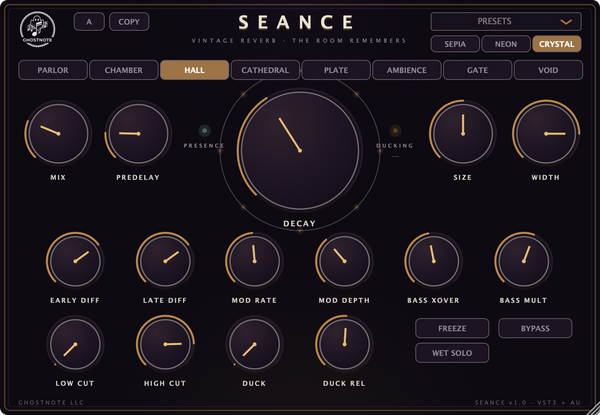
Ours is called SEANCE, and it is a reverb rather than a delay, so it covers half of this article. It is an eight-line modulated feedback delay network with eight room modes (Parlor, Chamber, Hall, Cathedral, Plate, Ambience, Gate and Void) and three eras: SEPIA is dark early-digital, NEON is the bright 80s rack, CRYSTAL is clean and modern.
The controls this article spends its time on are on the front panel rather than on a separate EQ. Pre-delay runs 0 to 500 ms. Decay runs 0.2 to 70 s. The wet low cut sweeps 20 to 500 Hz and the wet high cut 1 to 20 kHz, both on the wet path only, so the return filtering above happens inside the plugin. DUCK runs 0 to 100 percent, up to about 26 dB of dip, with its own release from 50 to 1000 ms, which is the sidechain setup from the ducking section with no routing to build. WET SOLO mutes the dry path while you shape the tail.
Two numbers from the impulse-response measurements in its manual, taken at 48 kHz on version 1.0: a 2.0 s DECAY setting measures 1.99 to 2.02 s in every mode except GATE, which is gated by design, and the modes sit within about 3 dB of each other in loudness at equal settings, so switching compares the space rather than the volume.
Its factory preset for this job is Upfront Rap Plate: Plate mode, Neon era, mix 16 percent, pre-delay 12 ms, decay 1.4 s, low cut 150 Hz, high cut 11 kHz, DUCK at 65 percent with a 220 ms release. That is a tighter and more forward starting point than the send numbers in this article, because it is built to sit as a mix control. If you run it on a shared send behind a dense beat, raise the pre-delay toward 30 ms and the low cut toward 400 Hz.

Vintage reverb · $29
Ghostnote SEANCE
Eight rooms across three eras of digital character, all loudness-matched so switching compares the space and not the volume. The ducker steps the tail aside while the vocal speaks, with no sidechain routing to set up.
See SEANCE →What it is not: a convolution reverb. It will not load an impulse response, so if you need a specific measured hall, this is the wrong tool and a convolution plugin is the right one. It is also not a delay, and we do not make one. For the delay half of this article your DAW's stock tempo delay does everything described above, and Valhalla's free Supermassive does a stranger version of it.
SEANCE is $29. VST3 on macOS and Windows, AU on macOS, keyless: no license key, no iLok, no account, and it installs on every computer you own. The rest of the line is on the Ghostnote plugins page.
Frequently Asked Questions
How much reverb should you put on rap vocals?
Less than it feels like while you are setting it. Set the send by muting the return rather than soloing it: if the vocal changes size, the level is right; if it changes loudness, the send is too high. On a dense verse most of the perceived space should come from a delay and a short 0.8 s plate, with the return ducked 3 to 6 dB under the dry vocal.
What reverb settings are best for rap vocals?
A plate or short room at 0.6 to 1.2 s of decay, 20 to 40 ms of pre-delay, and the return high-passed at 300 to 500 Hz and low-passed at 6 to 8 kHz. Save halls of 1.8 s and longer for hooks and for throws on a send that stays at zero the rest of the time. De-ess the send 4 to 8 dB, harder than you would ever de-ess the vocal.
What delay settings should you use on rap vocals?
A dotted eighth with feedback at 20 to 30 percent is the default, because it lands between the beats instead of on the snare. At 140 BPM that is 321.4 ms: 60000 divided by the tempo gives the quarter note, and a dotted eighth is three quarters of it. Use a quarter for throws with feedback at 35 to 50 percent, and match triplet flows with a triplet eighth rather than fighting them with a dotted value.
Should reverb and delay go on sends or on inserts?
Sends. On an insert, every processor downstream of the vocal compresses, saturates and limits the tail as if it were the voice, and you lose the ability to filter or duck the wet signal on its own. The exception is a part where the wet signal is the performance, such as a hard-tuned hook printed with its delay, which you print and mix as its own track.
Why do my rap vocals sound washed out?
Usually the decay is too long for the syllable rate rather than the send being too loud. At 140 BPM a sixteenth note falls every 107 ms, so a 1.8 s tail is still sounding about 17 syllables later. Shorten the decay to 0.8 s, raise pre-delay to 30 to 40 ms, move the return high-pass up to 500 Hz, and duck the return 5 to 8 dB. If it is still washy, use a delay instead.
The plugins in this guide
The Ghostnote tools this piece is built around. VEIL, our de-esser, is free.
See all music producer outfits →